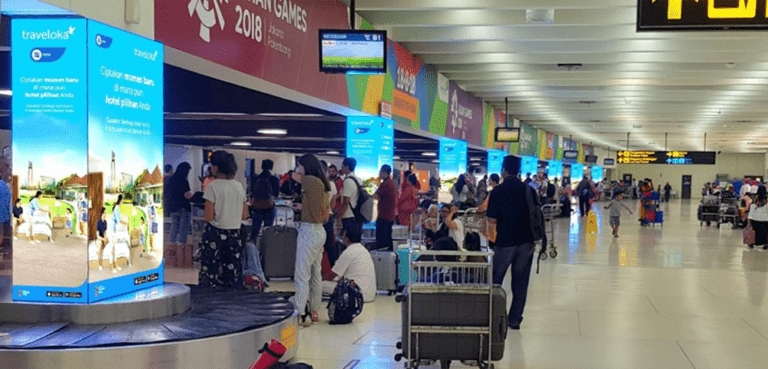
Travel brands expanding across Southeast Asia need more than digital ads — they need to intercept audiences at the right physical touchpoints. This guide breaks down how OOH advertising works market by market for airlines, OTAs, hotels, and travel services.
Travel brands operate in one of the most competitive advertising environments in Southeast Asia. Airlines, online travel agencies, hotels, visa services, and insurance providers are all chasing the same customer — a mobile, aspirational, digitally active consumer who is planning, booking, or about to depart. The challenge isn't reach. It's interception: catching that consumer at exactly the right moment, in exactly the right physical space, before they've committed their wallet elsewhere.
That's precisely where out-of-home advertising delivers something no programmatic campaign, social ad, or search keyword can replicate. OOH meets the traveller where they physically are — at the airport check-in hall, on the highway approaching the ferry terminal, in the shopping mall near the visa application centre, or on the city street they walk down every day on the way to work. For travel brands planning regional campaigns across Southeast Asia, understanding how OOH operates market by market is the difference between a campaign that performs and one that simply runs.
Why OOH Is a Natural Fit for Travel Brands
Travel advertising has always relied on aspiration and urgency — two emotional triggers that OOH formats handle exceptionally well. A large-format digital billboard featuring a coastal destination at golden hour creates desire at scale. A well-placed airport lightbox catches a traveller mid-journey when their receptivity to flight deals, hotel upgrades, and travel insurance is at its peak. A ferry terminal display reaches inbound and outbound international passengers in a captive, dwell-heavy environment with nothing else competing for their attention.
Unlike digital channels, OOH cannot be skipped, blocked, or scrolled past. This is especially significant in Southeast Asia, where ad-blocker usage is rising and social media feeds are saturated with travel content from competing brands. The physical presence of OOH — its permanence in a commuter's daily journey, or its authority at a major transit hub — builds brand credibility over time in a way that a 15-second pre-roll never quite achieves.
Travel brands like Traveloka and Jetstar Asia have already demonstrated the effectiveness of OOH in the region — running multi-market campaigns across Singapore and beyond that combine high-visibility roadside formats with precision placement in transit-adjacent environments.
The Southeast Asia Travel OOH Landscape by Market
Southeast Asia is not a single market. Media infrastructure, regulatory frameworks, audience behaviour, and OOH format maturity vary significantly from country to country — and even city to city. Here's what travel brands need to understand across the key markets:
Singapore
Singapore is the most media-mature OOH market in the region and functions as the natural launchpad for regional travel campaigns. The city-state's compact geography means that high-traffic nodes — Orchard Road, the CBD, Changi Airport, ferry terminals — can be activated simultaneously for genuinely mass coverage. For travel brands, Singapore's ferry terminals are particularly powerful. The Harbourfront ferry terminals serve passengers connecting to Batam and Bintan in Indonesia, representing a concentrated audience of leisure travellers and regional business commuters who are, by definition, in active travel mode.
TPM owns media at both Harbourbay and Batam Centre Ferry Terminals, creating a rare two-country corridor — a Singapore departure point and an Indonesia arrival point — where travel brands can maintain continuous visibility throughout a single journey. This kind of journey-mapping is difficult to replicate in digital alone.
Indonesia
Indonesia is one of the most dynamic OOH markets in Southeast Asia. Jakarta alone has a daily commuter population that rivals major global cities, and the archipelago's airport network — managed by PT Angkasa Pura I and PT Angkasa Pura II — covers 40+ airports serving over 270 million people. For travel brands targeting domestic Indonesian travellers, airport OOH is indispensable. TPM has direct relationships with both PT Angkasa Pura I and PT Angkasa Pura II — not through a reseller, but as a direct media partner — giving clients access to departure lounges, check-in halls, and landside corridors at airports across the country with the kind of lead time and placement quality that reseller arrangements typically cannot match.
Outside airports, Jakarta's arterial road network — Jalan Sudirman, Jalan Thamrin, the toll roads connecting to Soekarno-Hatta — carries massive daily traffic and hosts large-format billboards that travel brands use for brand-building campaigns. Indonesia also has a strong mobile-first consumer base, making DOOH formats with dynamic content particularly effective for time-sensitive promotions like flash sales or limited-seat fares.
Vietnam
Vietnam's OOH market is rapidly professionalising, particularly in Ho Chi Minh City and Hanoi. The country's two major cities have distinct audience profiles: Ho Chi Minh City skews towards younger, entrepreneurial, and aspirational consumers who are highly responsive to lifestyle travel brands; Hanoi carries a slightly more conservative, government and corporate-adjacent audience that responds well to premium positioning. For travel brands, Vietnam's growing middle class — and its surging appetite for international outbound travel — makes it a critical OOH market. TPM operates through a subsidiary in Vietnam, providing local execution capabilities that pure regional agencies simply cannot offer.
Myanmar
Myanmar's market context has changed significantly in recent years, and campaign planning here requires careful regulatory and operational guidance. TPM maintains a subsidiary presence and can advise brands on the current state of media access and execution feasibility in-market.
TPM provides direct media access, airport relationships, and on-the-ground execution across Singapore, Indonesia, Vietnam, and beyond — from brief to post-campaign monitoring.
Plan Your SEA OOH Campaign with TPM
Key OOH Formats for Travel Brands
Different formats serve different objectives within a travel brand's campaign architecture. Here's how to think about format selection across Southeast Asia:
| OOH Format | Best Campaign Objective | Key Markets | Travel Brand Use Case |
|---|---|---|---|
| Airport Media (Landside & Airside) | Captive audience, high dwell time | Singapore, Indonesia, Vietnam, Philippines | Airline route launches, OTA app downloads, hotel brand awareness |
| Ferry Terminal Media | Journey interception, regional travellers | Singapore (Harbourfront), Batam | Resort packages, visa services, travel insurance |
| Large-Format Roadside Billboards | Mass reach, brand building | Jakarta, HCMC, Manila, KL | Seasonal promotions, new route announcements, OTA brand campaigns |
| Digital OOH (DOOH) | Dynamic content, time-sensitive offers | Singapore, Jakarta, KL, Bangkok | Flash sales, fare countdowns, real-time destination promotions |
| Shopping Mall & Retail Media | Aspirational targeting, mid-funnel | Singapore, KL, Jakarta, Manila | Travel credit cards, hotel loyalty programmes, OTA seasonal campaigns |
| Street-Level & Transit Media | Frequency, commuter targeting | Singapore, Bangkok, HCMC | Budget airline promotions, travel app awareness, package deal advertising |
Strategic Location Planning for Travel OOH
For travel brands, location intelligence is everything. The most effective OOH placements for travel advertising share a common logic: they are either adjacent to where travel decisions are made, or they intercept travellers in active journey mode. Here are the location typologies that consistently perform for travel brands in Southeast Asia:
Airports
Airport OOH reaches an audience that has self-selected as a traveller. Whether they're departing, arriving, or transiting, they are in a mindset that makes them disproportionately receptive to travel-adjacent advertising — airline upgrades, car hire, hotel booking, destination experiences, travel insurance. Airport media placements in Indonesia's major airports, accessed through TPM's direct relationship with PT Angkasa Pura I and II, offer brands coverage across both primary international gateways and the domestic network — critical for campaigns targeting the Indonesian outbound travel market.
Ferry and Ground Transportation Terminals
Often overlooked in regional media plans, ferry terminals concentrate a specific audience type that is extremely valuable to travel brands: people who travel regularly, across borders, and who are comfortable with cross-market services. Ferry terminal media at Singapore's Harbourfront complex reaches Singaporean and Malaysian leisure travellers, Indonesian workers and visitors, and regional tourists — all in a single, dwell-heavy environment.
Shopping Malls and Retail Complexes
In Southeast Asian cities, shopping malls are not just retail destinations — they are social and aspirational spaces where consumers browse travel options, apply for credit cards, and compare holiday packages. TPM's owned inventory at People's Park Complex and Mustafa Centre in Singapore sits within communities — the Chinese and South Asian diaspora — that are heavy outbound travel consumers, often seeking deals on flights and accommodation to home markets or regional destinations.
High-Footfall Urban Corridors
City-centre OOH placements build the brand frequency that supports direct response campaigns across other channels. In Singapore, for example, a travel brand running app-install campaigns on social media will see measurably better conversion rates when supported by consistent OOH presence in high-footfall corridors. The Orchard Flagship DOOH and CBD corridor placements reach the precise professional demographic — frequent travellers, business executives, and aspirational consumers — that premium travel brands target.
Regulatory Considerations for Travel OOH in SEA
Travel brands running OOH campaigns across Southeast Asia need to be aware of regulatory variation. This is not a market where a single creative execution can be deployed uniformly across all countries without review:
- Singapore: Well-regulated, transparent permitting through the Land Transport Authority and URA. Creative content must comply with ASA guidelines — particularly for promotional claims on fares and pricing.
- Indonesia: Billboard permitting is administered at the municipal level (Dinas Reklame), meaning a Jakarta approval does not extend to Surabaya or Bali. Creative featuring foreign destinations or comparative pricing claims requires careful legal review. Airport inventory is governed by separate airport authority permissions.
- Vietnam: OOH advertising is regulated by the Ministry of Culture, Sports and Tourism, and all outdoor advertisements require a permit. Content featuring foreign destinations must avoid any implication that Vietnam's domestic options are inferior — a nuance that catches international travel brands off guard.
- Philippines: Local government units (LGUs) issue billboard permits, leading to a fragmented regulatory environment. Metro Manila, Cebu, and Davao have distinct permitting timelines and size restrictions.
- Thailand: Bangkok's OOH environment is heavily competitive, with premium locations in high demand. Creative featuring promotional fares must comply with the Consumer Protection Act's standards on advertising claims.
Campaign Planning Timeline for Regional Travel OOH
Travel brands typically plan OOH around seasonal peaks — school holidays, major public holidays, and peak booking windows (usually 6–12 weeks before the travel period). For a regional SEA campaign, the following timeline applies:
- 12–14 weeks out: Market selection, format planning, budget allocation by country, regulatory pre-assessment
- 10–12 weeks out: Media booking and space reservation — particularly critical for airport inventory and DOOH, which sells out in peak seasons
- 8–10 weeks out: Creative development and localisation by market — language, imagery, regulatory compliance
- 6–8 weeks out: Production, printing, and digital asset submission deadlines
- 4–6 weeks out: Installation and go-live confirmation, proof-of-posting documentation
- During campaign: Monitoring, reporting, and dynamic content updates where DOOH formats allow
- Post-campaign: Audience delivery reporting, site photography, cross-channel attribution analysis
Working with a Regional OOH Partner
The complexity of running OOH for a travel brand across 5–8 Southeast Asian markets simultaneously — coordinating permits, creative localisation, production, installation, and reporting — is substantial. The brands that execute this most effectively are those that consolidate their OOH planning with a single regional partner who has genuine on-the-ground presence, owned inventory, and existing authority relationships across multiple markets.
TPM's combination of owned Singapore media, Indonesian airport authority relationships, and subsidiary operations in Vietnam and Myanmar means that a travel brand brief submitted to one team can be executed across a genuinely connected regional network — with consistent quality control, transparent reporting, and the kind of strategic counsel that a local reseller in each market simply cannot provide.
The traveller's journey spans borders. Your OOH campaign should too.
TPM's regional team can build a tailored, multi-market OOH plan — from airport media in Indonesia to ferry terminals in Singapore and city formats across Vietnam and beyond.
Plan Your SEA OOH Campaign with TPM