Indonesia's scale, diversity, and urban density make it one of Southeast Asia's most powerful OOH markets. Here's what regional marketers need to know to plan effectively across Java, Sumatra, and beyond.
Indonesia is not a single market. It is 17,000 islands, 270 million people, and at least a dozen major urban centres each with its own consumer culture, traffic patterns, and media landscape. For regional marketing managers expanding into or scaling across the archipelago, this complexity is both the challenge and the opportunity. Out-of-home advertising remains one of the most powerful tools available — but only when it is deployed with genuine ground-level understanding of how Indonesian cities actually work.
This guide is designed to give you a working framework for OOH strategy in Indonesia: where audiences are, which formats perform, how the regulatory environment shapes what is possible, and why the right regional partner makes the difference between a campaign that reaches millions and one that simply exists on a street corner.
Why Indonesia Demands Its Own OOH Strategy
Indonesia is consistently ranked among the top five most digitally active countries in the world — and yet OOH advertising continues to grow here precisely because of that digital density. In cities like Jakarta, Surabaya, Medan, and Makassar, daily commute times regularly exceed 90 minutes. People are physically present in public spaces for extended periods. Screens and billboards are part of the built environment in a way that is unavoidable. Unlike social media feeds that can be scrolled past or streaming ads that can be skipped, outdoor media cannot be turned off.
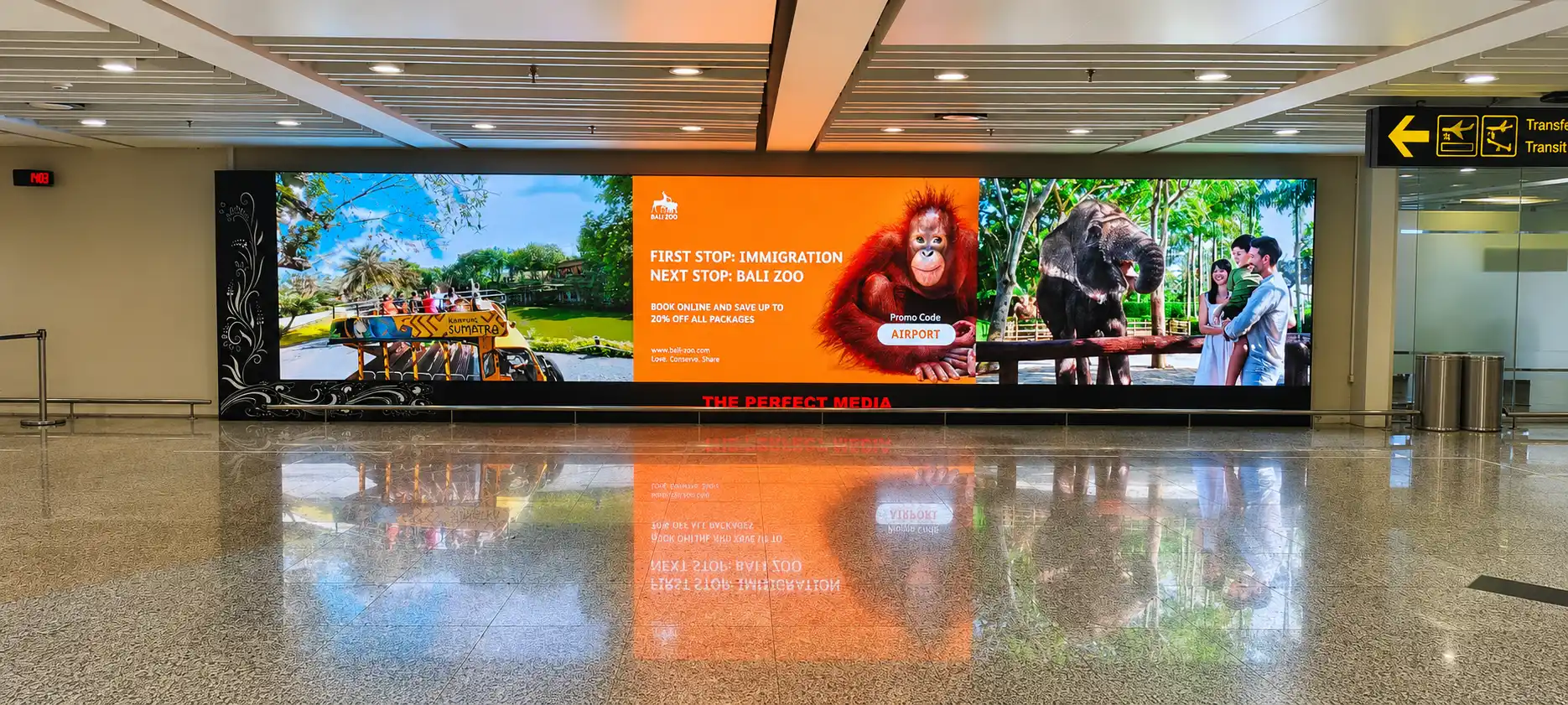
The Indonesian OOH market is also distinguished by its sheer format diversity. Large-format static billboards remain dominant across secondary cities. Digital out-of-home (DOOH) is expanding rapidly in Jakarta's CBD and premium retail corridors. Airport media commands premium audience quality at Soekarno-Hatta, Ngurah Rai (Bali), and Juanda (Surabaya). Transit media — including in-station and bus shelter formats — is growing in line with MRT and LRT expansion in the capital.
City-by-City Intelligence: Where to Concentrate Your Budget
Jakarta
Jakarta remains the undisputed centre of Indonesian commercial life. With a Greater Jakarta population exceeding 34 million and a daily CBD workforce drawn from across Jabodetabek, this is where national brands establish authority. Key OOH corridors include Sudirman–Thamrin (the commercial spine), Gatot Subroto, and the toll road approaches to the airport. Premium DOOH inventory is concentrated around Bundaran HI, Grand Indonesia, and Pacific Place. The Jakarta MRT — still expanding — offers transit media opportunities particularly valuable for financial services, tech, and FMCG brands targeting commuters aged 25–45.
Surabaya
Indonesia's second city is frequently underestimated by marketers who treat Java as a Jakarta-only proposition. Surabaya has a distinct commercial identity — manufacturing, trade, and a large Chinese-Indonesian business community — and its OOH landscape reflects this. The Darmo–Mayjen Sungkono corridor is the premium billboard zone. Juanda International Airport serves as a gateway for East Java and is a critical touchpoint for B2B and travel-adjacent brands.
Bali
Bali operates as a separate media market entirely. Tourism-driven footfall means the audience profile is radically different — international visitors, domestic tourists, hospitality and F&B decision-makers. Airport media at Ngurah Rai is arguably the most valuable OOH touchpoint on the island, capturing travellers at moments of high purchase intent. The Kuta–Seminyak–Canggu corridor and the approach roads to Ubud and Nusa Dua each reach distinct visitor segments.
Medan and Makassar
Both cities are regional commercial hubs with significant population bases (Medan serves North Sumatra; Makassar is the gateway to Eastern Indonesia) and relatively lower OOH competition than Java. For brands building national reach or targeting specific ethnic and regional audiences, these cities offer strong impact per rupiah. Static large-format billboards dominate, with DOOH penetration still limited to premium retail and hotel districts.
Format Availability and Performance by Context
| Format | Best Markets | Typical Audience | Notes |
|---|---|---|---|
| Large-Format Static Billboard | All major cities | Commuters, general public | Dominant format outside Jakarta; long dwell campaigns |
| Digital OOH (DOOH) | Jakarta, Surabaya, Bali | CBD professionals, premium shoppers | Expanding rapidly; dayparting and dynamic content possible |
| Airport Media | Jakarta, Bali, Surabaya, Medan | Business travellers, tourists, C-suite | TPM has direct relationships with PT Angkasa Pura I & II |
| Transit Media (MRT/LRT) | Jakarta | Urban professionals, students | Growing inventory as Jakarta rail network expands |
| Mall / Retail DOOH | Jakarta, Surabaya, Bali | Middle-upper income shoppers | High dwell time; strong for FMCG, fashion, F&B |
| Ferry Terminal Media | Batam, Bali | Cross-border travellers, business commuters | TPM operates Harbourbay & Batam Centre Ferry Terminals |
The Airport Media Advantage in Indonesia
No other OOH format in Indonesia delivers the consistent audience quality of airport media. Soekarno-Hatta International Airport handles over 60 million passengers annually in normal operating years, making it one of the busiest airports in Asia. Ngurah Rai in Bali and Juanda in Surabaya each serve millions more. The traveller audience — whether domestic business flyer or international visitor — is typically higher-income, more educated, and making purchase decisions at scale.
The critical distinction for marketers planning Indonesian airport campaigns is access quality. Many agencies act as resellers of airport inventory, adding layers of cost and reducing responsiveness. The Perfect Media Group holds direct relationships with both PT Angkasa Pura I and PT Angkasa Pura II — the two state-owned entities that collectively manage Indonesia's major commercial airports. This means faster approvals, direct negotiation, and the ability to construct genuinely integrated airport campaigns rather than simply booking available slots. For brands in travel, financial services, automotive, and luxury, this is a material operational advantage. Explore how airport media can anchor your Indonesian campaign.
The Perfect Media Group operates directly across Indonesian airports and cities — from Jakarta's commercial corridors to Bali's tourism hubs — with no reseller layers between your brand and the media.
Plan Your SEA OOH Campaign with TPM
Regulatory Context: What Marketers Must Know
Indonesia's OOH regulatory environment operates at multiple levels simultaneously. National guidelines set baseline rules on content (no alcohol advertising in public space, restrictions on tobacco imagery, Bahasa Indonesia requirements for certain categories), while provincial and city governments issue their own permits and in some cases impose additional restrictions on billboard dimensions, placement near religious sites, or density in specific corridors.
Jakarta's Dinas Penanaman Modal dan Pelayanan Terpadu Satu Pintu (DPMPTSP) governs billboard permits in the capital, and the application process can take several weeks for new permanent structures. Brands planning campaign-specific or event-driven OOH need to build permit lead times into their production schedules. In Bali, additional sensitivities apply around religious sites and traditional villages — campaigns near puras (temples) or on roads designated as ceremonial routes require specific clearances.
Working with a locally established partner who understands this regulatory landscape in each city is not optional — it is the difference between a campaign that launches on schedule and one that stalls at the permit stage.
Audience Segmentation Across Indonesian Cities
| City | Primary OOH Audience | High-Value Segments | Key Buying Categories |
|---|---|---|---|
| Jakarta | 34M+ metro population | CBD professionals, upper-middle class families | Finance, automotive, tech, FMCG, real estate |
| Surabaya | 9M+ metro population | Trade/business community, manufacturing sector | B2B, logistics, property, FMCG |
| Bali | 6M+ residents + 6M+ annual visitors | International tourists, domestic leisure travellers | Hospitality, F&B, luxury, travel, lifestyle |
| Medan | 4M+ metro population | Chinese-Indonesian business community, young urban | FMCG, retail, mobile/tech, financial services |
| Makassar | 3M+ metro population | Government, trade, regional business | Infrastructure, property, FMCG, services |
Campaign Planning Considerations for Indonesia
Lead Times Are Longer Than You Think
Between regulatory permits, production timelines for large-format printing, and logistics across a geographically dispersed country, Indonesian OOH campaigns require meaningful lead time. For a multi-city static campaign across Jakarta, Surabaya, and Bali, plan for a minimum of six to eight weeks from brief to posting. Airport campaigns through PT Angkasa Pura require their own approval processes. DOOH campaigns in Jakarta can move faster — sometimes within two to three weeks — but creative assets must meet specific technical specifications for each screen network.
Localisation Is Not Optional
Indonesia is a linguistically and culturally diverse country. Bahasa Indonesia functions as the national language across all markets, but Javanese, Sundanese, Batak, Balinese, and Makassarese cultural references carry significant weight in their respective regions. A campaign creative developed for Jakarta's cosmopolitan CBD will land differently in Medan or Makassar. The most effective OOH campaigns in Indonesia use national brand messaging with locally resonant visual or copy choices. TPM's in-house creative services team understands these nuances from direct market experience.
Integrate Digital and OOH for Maximum Reach
Indonesia's mobile-first consumer population means that OOH campaigns perform significantly better when integrated with digital touchpoints. A billboard on Sudirman paired with geo-targeted mobile advertising in the surrounding radius creates a compounding effect — OOH builds awareness at scale, digital retargets the exposed audience with conversion-focused messaging. This integrated approach has been used to strong effect by TPM clients including Traveloka, whose regional campaign demonstrated how airport and outdoor media can work in concert with performance digital channels. See the full Traveloka campaign case study for detail on how this was executed.
Seasonality and Cultural Calendar
Ramadan and Eid al-Fitr represent the single most important advertising period in the Indonesian calendar — comparable in scale to Christmas in Western markets but concentrated in a shorter window. Premium OOH inventory in Jakarta books out months in advance for this period. Other significant windows include Chinese New Year (particularly in Medan, Surabaya, and Pontianak where Chinese-Indonesian communities are concentrated), the year-end holiday period (November–December), and the Indonesian national holiday cluster around Independence Day in August. Brands entering the market should map these windows early and secure inventory accordingly.
Why a Regional Partner with Indonesian Roots Matters
The Indonesian OOH market rewards relationships. Permit processes, premium inventory allocation, and airport access are all navigated more effectively by partners with established presence on the ground. The Perfect Media Group has operated a subsidiary in Indonesia for years, with direct airport relationships through PT Angkasa Pura I and II and an active client base that includes regional and global brands running multi-format campaigns across Java, Bali, and Sumatra.
This is not a market where a Singapore or Kuala Lumpur-based agency can effectively plan and execute without genuine local infrastructure. And it is not a market where a local Jakarta agency can easily construct the cross-border campaign architectures that regional brands increasingly need — connecting Indonesia inventory with Singapore, Vietnam, or the Philippines within a single strategic framework.
TPM occupies both positions: locally rooted in Indonesia, regionally structured across 12 countries and 20 cities. For brands that need Indonesia to connect to a wider Southeast Asia strategy — whether that means a Singapore launch followed by Indonesian expansion, or a Pan-ASEAN campaign that anchors on Jakarta and Bali — this dual capability is the practical differentiator.
The Perfect Media Group combines direct Indonesian airport access, city-level OOH inventory, and full regional network coverage to give your brand genuine reach from Jakarta to Singapore and beyond.
Plan Your SEA OOH Campaign with TPM