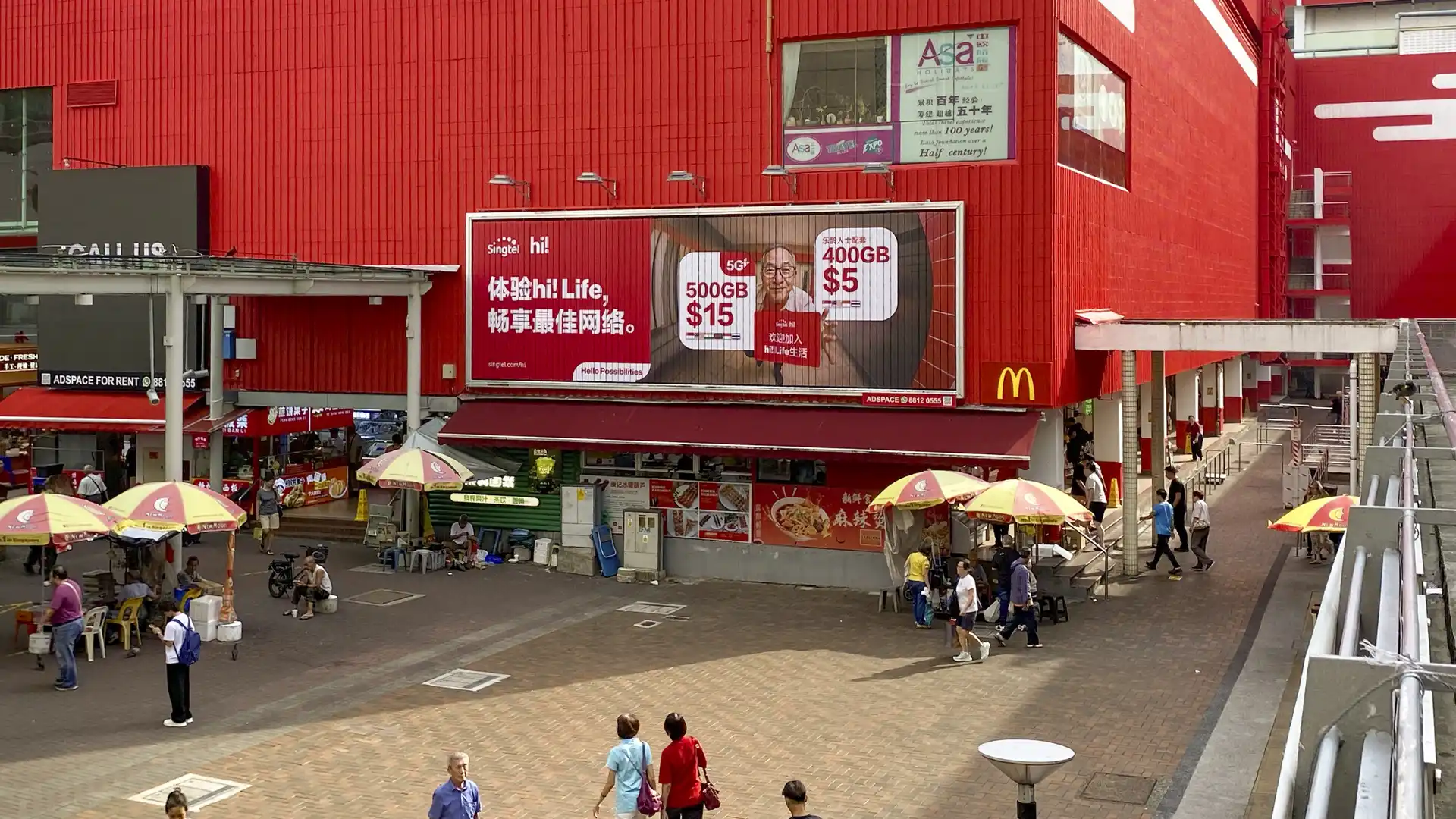
Telco brands in Singapore operate in one of the most competitive advertising markets in Asia. Discover how OOH advertising helps telcos build mass awareness, drive retail traffic, and defend market share — with strategic placement and format selection.
In Singapore, the telecommunications sector is one of the most aggressively marketed industries in the country. With four major network operators, dozens of mobile virtual network operators (MVNOs), and constant plan reshuffling to retain and acquire subscribers, the battle for consumer mindshare never pauses. Digital advertising alone — search, social, programmatic — cannot carry the weight of a category where trust, visibility, and presence are fundamental to winning. That is precisely why Out-of-Home (OOH) advertising remains one of the most strategically important channels for telco brands operating in this market.
This guide breaks down how telco marketers in Singapore can use OOH effectively — from format selection and location strategy to audience targeting and campaign integration — with honest, practical insights drawn from real campaign experience in this market.
Why OOH Is Uniquely Well-Suited for Telco Marketing
Telecommunications brands face a specific set of marketing challenges that OOH is structurally built to address:
- Mass reach at launch: When a new plan, device, or brand is introduced, reaching a broad audience quickly is essential. OOH delivers scale and frequency that digital channels cannot replicate at the same cost-per-thousand for general population coverage.
- Cannot be skipped or blocked: Unlike pre-roll video or display ads, OOH is part of the physical environment. A commuter on Orchard Road cannot install an ad blocker on a billboard. This is TPM's core belief — outdoor media is the one format your audience cannot turn off.
- Retail proximity drives conversions: Telco stores are physical destinations. Placing OOH near Singtel, StarHub, or M1 outlets — or near shopping mall entrances — bridges awareness to purchase intent in a way that purely digital campaigns cannot.
- Reinforces digital campaigns: OOH acts as a high-visibility primer that makes your digital ads more effective. Studies consistently show that consumers who see an OOH ad first are more likely to engage with a subsequent digital touchpoint.
- Credibility and brand stature: A large-format billboard on a prime Singapore junction signals market leadership. In a category where consumers make multi-year service commitments, perceived brand strength influences the decision.
The Telco OOH Playbook: Key Campaign Objectives and How OOH Addresses Each
1. Subscriber Acquisition Campaigns
When launching a new SIM-only plan, postpaid bundle, or promotional offer, speed and reach are the priority. High-traffic junctions and transit corridors are ideal for this. Formats like large digital billboards at major intersections and transit stations ensure the message reaches the broadest audience in the shortest timeframe. Key creative elements — clear headline, price point, and a strong call-to-action — work well on OOH because of the high frequency of repeated exposures.
2. Device Launch Campaigns (Smartphones, Routers, Devices)
Device launches — particularly when a telco is the exclusive or preferred distributor of a flagship smartphone — benefit enormously from premium OOH placements that can showcase the product visually. Large-format static and digital formats in high-dwell areas such as shopping districts and transport interchanges are particularly effective for product imagery. This is where Digital OOH shines, allowing high-resolution video creative to showcase product features in motion.
3. Brand Repositioning and Equity Campaigns
When telcos rebrand, launch sub-brands, or shift their positioning (e.g., moving from connectivity to lifestyle or enterprise services), OOH provides the canvas for brand storytelling at scale. This is a longer-term play that benefits from sustained presence across multiple sites — building familiarity and shifted perception over weeks and months, not days.
4. Localised Retail Traffic Campaigns
Driving foot traffic to specific store locations — new outlet openings, trade-in events, or in-store promotions — calls for hyper-local OOH strategy. Street-level formats within 500 metres of a telco store outlet, combined with directional creative, are highly effective at converting ambient awareness into physical visits.
TPM's media strategists have run multi-site OOH campaigns for major telcos and can help you map format, placement, and budget to your specific subscriber acquisition or brand goals.
Talk to a TPM Strategist
Format Selection Guide for Telco OOH Campaigns
Not all OOH formats serve the same purpose. Here is a practical breakdown of the main formats available in Singapore and how they map to telco campaign objectives:
| OOH Format | Best For | Audience Context | Typical Duration | Relative Cost |
|---|---|---|---|---|
| Large Digital Billboard (Junction DOOH) | Subscriber acquisition, device launch, brand awareness | Motorists, commuters, pedestrians at major intersections | 2–4 weeks | Medium–High |
| Large Static Billboard (Roadside) | Sustained brand presence, equity building | Motorists and road-level pedestrians | 1–3 months | Medium |
| Street-Level / Bus Shelter | Retail traffic, localised promotions, plan offers | Pedestrians, bus commuters at close range | 2 weeks – 1 month | Low–Medium |
| Building Facade / Landmark | Brand stature, rebranding, flagship launches | Broad street-level and elevated visibility | 1–3 months | High |
| Shopping Mall Media | Device launch, in-store retail activation | Shoppers in high-intent purchase environment | 2–4 weeks | Medium |
| Airport Media | Roaming plans, enterprise services, premium brand image | Frequent travellers, business professionals, high-income segments | 1–3 months | Medium–High |
Location Strategy: Where Telco OOH Works Hardest in Singapore
Singapore is a compact city-state, but its districts are highly segmented by audience profile. Smart location selection is what separates efficient OOH spend from wasteful scatter-shot placement.
CBD and Business Districts
The Central Business District is prime territory for enterprise telco messaging — 5G business solutions, fixed broadband for offices, and mobile fleet plans. High-density foot traffic from professionals makes CBD placements ideal for upper-funnel messaging targeting decision-makers. The CBD Gateway on New Bridge Road is a prominent example of a site that captures this audience consistently at high volume throughout the business week.
Orchard Road and Retail Corridors
Orchard remains Singapore's premier retail and lifestyle corridor. For telco brands launching consumer plans, device bundles, or lifestyle-oriented sub-brands, Orchard Road placements carry both reach and brand prestige. Footfall here skews towards younger consumers, families, and tourists — a relevant mix for consumer telco campaigns.
Little India and Mustafa Centre Surrounds
This district is one of the most unique in Singapore's OOH landscape. Mustafa Centre draws a diverse audience that includes a significant South Asian expat community — a highly valuable segment for telco brands offering international calling plans, IDD bundles, and remittance-adjacent services. The Mustafa Grand Junction DOOH site captures this audience at one of Singapore's highest-traffic pedestrian intersections.
Chinatown and People's Park Surrounds
This precinct serves Singapore's Chinese-speaking community and tourist visitors, and sees particularly strong footfall during festive periods. For telco campaigns targeting mature consumers or running promotional activations tied to Chinese New Year or other cultural moments, this area offers strong community resonance.
Jalan Besar and Geylang Corridors
A dense residential and commercial mixed zone with strong commuter flow and significant migrant worker population — relevant for prepaid SIM campaigns, IDD and international calling promotions, and budget-oriented plan launches. TPM operates several key sites in this corridor including the Jalan Besar Grand Junction Vertical, which captures both vehicular and pedestrian traffic at a critical junction.
A Hypothetical Campaign Scenario: Launching a New SIM-Only Plan
Consider a scenario grounded in the realities of Singapore's market. A telco brand is launching a new SIM-only postpaid plan targeting young professionals aged 25–35. The plan is competitively priced and positions the brand as the challenger option against the incumbent operators. The marketing team has a four-week window and a mid-tier OOH budget.
Recommended OOH Strategy:
- Anchor sites (2–3 high-impact DOOH junctions): Placed at major commuter corridors — covering the CBD, Orchard, and a key MRT interchange — these drive mass awareness and frequency for the core target demographic of young working adults.
- Street-level support (5–8 bus shelter or street furniture units): Located within 300–500 metres of key telco retail outlets and near MRT stations with high young adult footfall, these reinforce the message at close range and provide a directional nudge toward the store.
- Creative execution: A clean, bold digital creative on DOOH screens leads with the price point and a memorable tagline. Static formats carry supporting information. All creatives maintain consistent visual language with the brand's concurrent digital campaign.
- Duration: Full four-week flight on anchor sites; street-level units refreshed at week two with a variation creative highlighting a specific campaign feature.
This is a realistic, executable campaign framework — not a theoretical ideal. It is the kind of approach TPM's strategists work through with clients during the briefing process, adjusting for budget, geography, and competitive context. Singtel's multi-site OOH campaign for their hi! brand is a real-world example of how this kind of multi-format, multi-location approach delivers measurable brand presence across Singapore.
Integrating OOH with Digital: The Modern Telco Media Mix
OOH does not operate in isolation for most telco campaigns. The most effective campaigns in 2026 treat OOH as the high-reach, high-credibility backbone of the media plan, with digital channels providing targeting precision and performance conversion.
Key integration principles for telco brands:
- Message consistency: The same key message, visual language, and offer must appear across OOH, social, and digital display. Inconsistency causes audience confusion in a competitive category where rivals are running simultaneous campaigns.
- OOH primes, digital converts: Use OOH to establish broad awareness and brand recognition; retarget audiences on social and search who have been exposed to OOH in specific geographic zones.
- QR codes on static OOH: For plan promotions, QR codes on static formats and bus shelters can bridge the physical impression to a digital sign-up or comparison page — particularly effective in Singapore where smartphone penetration is essentially universal.
- Geo-targeted mobile ads near OOH sites: Running mobile ads within a 500-metre radius of your active OOH placements during the campaign period amplifies total reach and recall significantly.
Measuring OOH Effectiveness for Telco Campaigns
One of the most common questions from telco marketing teams is: how do we know OOH is working? The answer lies in building measurement into the campaign structure from the outset.
- Brand recall and awareness lift surveys: Pre- and post-campaign brand tracking surveys in the geographic zones covered by OOH placements reveal measurable shifts in unaided awareness and message recall.
- Retail footfall uplift: Tracking in-store foot traffic at telco outlets near active OOH sites versus control locations identifies any incremental lift attributable to OOH proximity.
- Digital uplift from OOH geo-zones: Monitoring organic search volume for your brand or plan name, as well as website direct traffic, in areas where OOH is active versus inactive provides a useful proxy metric.
- QR code scan tracking: For campaigns using QR codes on static OOH, direct attribution is measurable and reportable at the campaign level.
What to Look for in an OOH Partner for Telco Campaigns
Not all OOH agencies offer the same level of strategic support. Telco campaigns — with their complex offer mechanics, competitive environment, and high creative requirements — demand a partner who goes beyond simply booking billboard space.
The right OOH partner for a telco brand should offer:
- Owned inventory in key locations (not purely a reseller), enabling faster turnaround and direct site access
- Strategic planning capability — audience profiling, format recommendation, and competitive mapping
- Creative services or creative review to ensure OOH-optimised execution
- Post-campaign monitoring and reporting, not just site booking confirmation
- Multi-market capability if the campaign extends beyond Singapore into the region
TPM operates as a full-service OOH partner — from initial brief and site recommendation through creative review, production, installation, and post-campaign monitoring. With over 30 owned media locations in Singapore and a network spanning 20 cities across Southeast Asia, the scope to build integrated, regionally consistent campaigns is genuine, not theoretical.
TPM's team can develop a tailored OOH strategy — from site selection across Singapore's key districts to regional campaign execution across Southeast Asia.
Talk to a TPM Strategist
Final Thoughts
Singapore's telco market rewards brands that show up consistently, credibly, and at scale. OOH advertising is one of the few channels that delivers all three simultaneously — and unlike every other medium, it cannot be muted, skipped, or scrolled past. For telco marketers looking to acquire subscribers, launch devices, build brand equity, or drive retail traffic, a well-planned OOH strategy is not a supplementary line item. It is a core pillar of a market-leading media plan.
The question is not whether OOH should be part of your telco campaign. The question is how to deploy it strategically enough to outmanoeuvre a competitive field of operators all fighting for the same consumer attention. That is where format discipline, location intelligence, and an experienced OOH partner make all the difference.