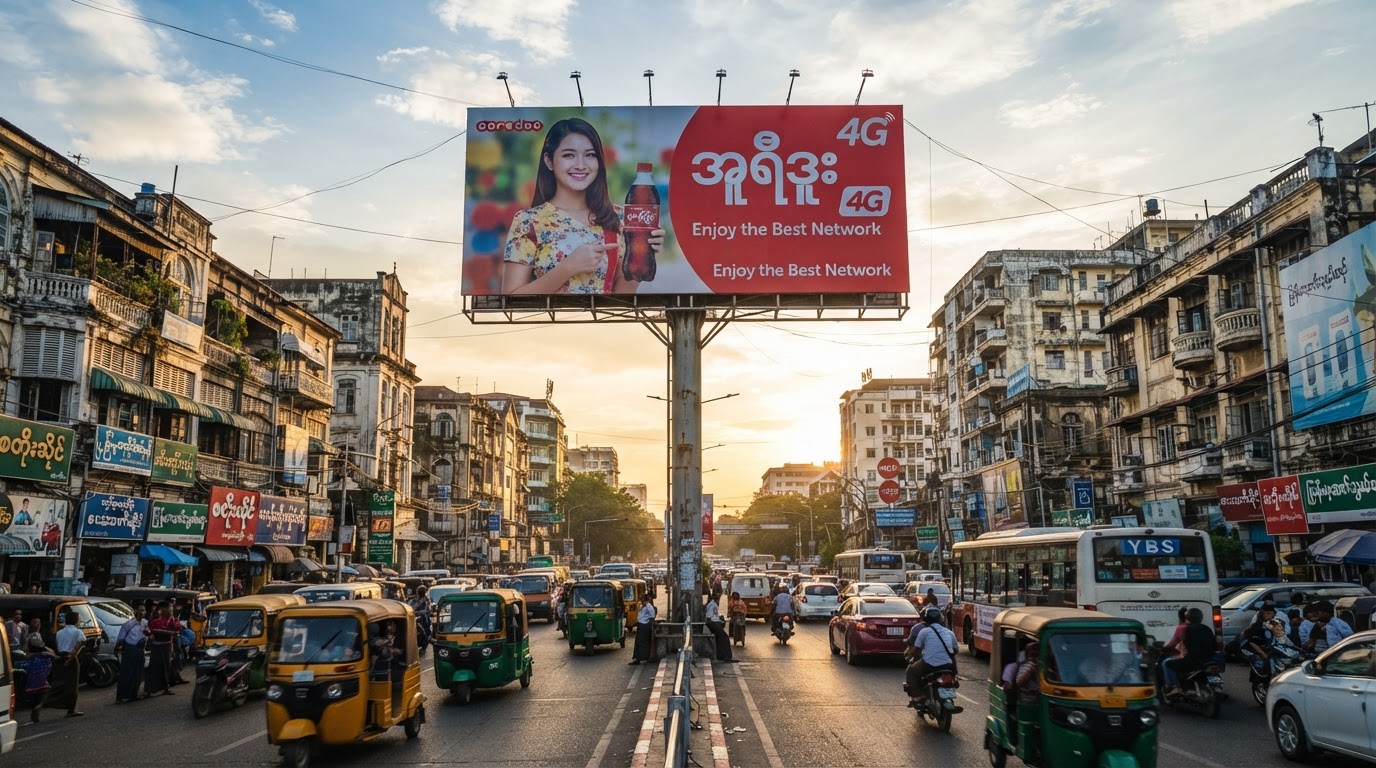
Yangon remains Southeast Asia's most underutilised OOH market — with high foot traffic, a young urban population, and limited advertiser competition. Here's what regional marketers need to know before planning a billboard campaign in Myanmar.
Myanmar sits at an unusual crossroads for regional marketers: a country with a large, youthful population, a sprawling commercial capital in Yangon, and an outdoor advertising landscape that remains significantly less saturated than neighbouring markets like Bangkok, Jakarta, or Ho Chi Minh City. For brands willing to navigate the market with the right local partner, billboard advertising in Yangon offers something increasingly rare across Southeast Asia — genuine share of voice at scale, in a city of over seven million people.
This guide is written for brand directors and media planners evaluating Myanmar as part of a broader Southeast Asia OOH strategy. We'll cover the market fundamentals, the audiences that matter, the formats available, regulatory considerations, and what experienced campaign planning looks like on the ground.
Why Yangon Matters for OOH Advertising
Yangon is Myanmar's commercial, financial, and cultural hub. It houses the country's largest concentration of middle-class consumers, multinational corporate offices, retail destinations, and international hospitality brands. While political and economic turbulence since 2021 has reshaped the operating environment, significant commercial activity continues — and outdoor media remains one of the most reliable, uninterrupted channels available to advertisers.
Unlike digital or broadcast channels that depend on consistent internet infrastructure or regulatory clearance, outdoor advertising reaches Yangon's population continuously. The city's persistent road congestion — a result of rapid motorisation and an infrastructure network that hasn't kept pace — actually works in favour of OOH advertisers. Commuters and passengers spend extended time at eye level with billboard placements along major arterial roads, creating high-frequency, high-dwell-time exposure that few other channels can match.
Critically for regional brand builders, Myanmar's outdoor advertising market is still developing compared to more mature ASEAN economies. Fewer advertisers competing for premium placements means your brand can occupy dominant positions at a fraction of the cost you'd pay in Singapore, Kuala Lumpur, or Jakarta's CBD.
Yangon's Audience Landscape
Understanding who you're reaching is essential before planning any OOH campaign. Yangon's consumer base is not monolithic — the city contains distinct audience clusters that respond to different locations, formats, and messaging approaches.
The Urban Professional Commuter
Yangon's growing class of office workers, business owners, and mid-level managers commutes daily along major arterials including Pyay Road, Insein Road, and the ring road network. This segment is aspirational in outlook, increasingly brand-aware, and responsive to financial services, FMCG, automotive, and technology advertising. Premium billboard placements along these corridors reach this audience at high frequency.
The Young Urban Consumer
Myanmar has one of Southeast Asia's youngest population profiles — a significant portion of Yangon's residents are under 35. This segment congregates around commercial areas like Sule Square, Kyauktada township, Junction City, and the Hledan intersection. They are mobile-first in their media habits, making OOH placements in these zones effective for driving brand recall that complements social and digital campaigns.
The International Business Visitor
Despite market shifts, Yangon continues to receive business travellers, regional executives, and expatriate professionals working across sectors including energy, manufacturing, and NGO operations. Airport-adjacent placements and key hotel corridors (Bogyoke Road, Inya Lake Road) remain relevant for brands targeting this inbound audience.
The Retail Shopper
Yangon's retail ecosystem — anchored by major centres like Junction City, Taw Win Centre, and local market precincts — generates high concentrations of consumer foot traffic. In-precinct and near-precinct OOH formats reach shoppers at the point of purchase decision, making them effective for consumer goods, personal care, and lifestyle brands.
Key OOH Locations Across Yangon
| Location / Corridor | Audience Profile | Best Format | Campaign Fit |
|---|---|---|---|
| Pyay Road (Hledan to Inya) | Urban professionals, expats, students | Large-format static billboard | Finance, automotive, telecoms |
| Sule Pagoda Road / CBD | Business visitors, office workers | Static & digital billboard | B2B services, banking, luxury |
| Bogyoke Aung San Road | Retail shoppers, tourists | Unipole, banner, wall-mounted | FMCG, fashion, telecoms |
| Insein Road Corridor | Mass market commuters, families | Large-format static billboard | Consumer goods, healthcare, education |
| Junction City Mall Surrounds | Young consumers, middle-class shoppers | Digital screen, retail OOH | Lifestyle, tech, F&B brands |
| Yangon International Airport (YGN) | Business travellers, regional visitors | Airport lightbox, digital display | Travel, finance, premium consumer |
| Mandalay Road (Northern Exit) | Industrial, logistics commuters | Large unipole billboard | B2B, industrial, building materials |
OOH Formats Available in Yangon
Myanmar's outdoor advertising inventory spans several core formats, though the market's development stage means digital OOH penetration is lower than in Singapore or Vietnam. Planning teams should be aware of what's genuinely available on the ground:
Large-Format Static Billboards
The dominant format across Yangon. These unipole and gantry structures along major roads offer high visibility and extended campaign durations. Standard sizes typically range from 10m × 5m to 20m × 7m, though non-standard configurations exist. Static OOH remains the most reliable format for mass-market reach in Myanmar, particularly outside the CBD core.
Digital OOH Screens
Digital billboard infrastructure in Yangon is growing but unevenly distributed. Concentrations of DOOH screens exist in and around Junction City, Sule Square, and select hotel precincts. Digital formats allow for dayparting, multiple creative rotations, and faster turnaround on campaign changes — valuable for brands running time-sensitive promotions or phased messaging. As infrastructure develops, digital OOH in Myanmar will increasingly mirror the flexibility brands already enjoy in Singapore or Ho Chi Minh City.
Airport Advertising at YGN
Yangon International Airport remains a key touchpoint for reaching regional business audiences. Lightboxes, banner placements, and digital displays across arrivals and departures target high-value travellers at a moment of heightened attention. For brands building regional credibility — particularly financial services, hospitality, and premium consumer goods — airport OOH in Myanmar complements placements in Singapore and Indonesian gateway airports.
Building Façades and Wall Murals
In high-density commercial precincts, building façade placements and hand-painted or vinyl wall murals provide large-canvas impact at street level. These formats have historically been popular with telecoms brands (Ooredoo, MPT, Mytel) and FMCG advertisers seeking saturation coverage in market districts and township commercial strips.
Transit and Street Furniture
Yangon's bus network and informal transit infrastructure creates opportunities for transit media — bus wraps, shelter panels, and street-level formats. Coverage varies significantly by township and operator relationships. These formats work best for mass-market consumer brands seeking broad urban penetration.
TPM has direct subsidiary operations in Myanmar and can advise on ground-level inventory, regulatory compliance, and integrated regional campaigns across 12 countries.
Plan Your SEA OOH Campaign with TPM
Regulatory and Operational Considerations
Myanmar's outdoor advertising regulatory environment requires careful navigation. Unlike Singapore's highly codified LTA framework or Indonesia's city-by-city permitting structure, Myanmar's billboard regulations involve multiple overlapping jurisdictions — the Yangon City Development Committee (YCDC), township administration offices, and sector-specific bodies depending on the placement type and advertiser category.
Key Regulatory Points for Advertisers
- Permit requirements: All permanent outdoor advertising structures in Yangon require YCDC approval. Temporary campaign installations (banners, event signage) are governed separately and typically require township-level clearance.
- Content restrictions: Myanmar has content guidelines affecting advertising across sectors including financial services, pharmaceuticals, and political/social messaging. Creative must be reviewed against current guidelines before production.
- Language requirements: While English-language OOH is accepted in international commercial zones, Burmese-language creative is expected for campaigns targeting general consumer audiences. Dual-language executions are common and recommended.
- Structure compliance: Physical billboard structures must meet municipal engineering standards. Working with established local operators who own compliant inventory is essential — non-compliant structures carry removal risk.
- Campaign timelines: Permit processing timelines in Yangon are longer and less predictable than in Singapore or Vietnam. Experienced operators typically advise building 4–6 weeks of permit lead time into campaign planning, particularly for new sites.
Campaign Planning: What Works in Yangon
Based on regional OOH campaign experience across Southeast Asia, several strategic principles consistently produce stronger results in the Myanmar market:
Lead with High-Reach Arterial Corridors
Yangon's traffic patterns concentrate audience exposure along a relatively small number of major road corridors. Brands that secure premium placements on Pyay Road, Insein Road, and the Sule–Bogyoke CBD core achieve disproportionate reach relative to site count. Rather than spreading budget thinly across many smaller sites, most effective campaigns anchor on 3–5 dominant corridor positions.
Localise Creative for Myanmar Audiences
Regional brand campaigns developed for Singapore or Jakarta rarely translate directly to Yangon without adaptation. Burmese language copy, locally resonant imagery, and an understanding of cultural nuance — particularly around colour, family representation, and religious sensitivities — make a measurable difference to campaign reception. TPM's creative services team supports localisation across regional markets, ensuring campaigns meet both regulatory and cultural standards in-market.
Complement OOH with Digital for Amplification
Myanmar's mobile internet penetration has grown significantly — Facebook in particular remains deeply embedded in daily consumer behaviour. OOH campaigns in Yangon perform better when coordinated with concurrent social and mobile activity that reinforces outdoor messaging. The physical presence of billboards drives brand salience; digital channels convert that awareness into engagement and action.
Plan for Extended Campaigns Over Short Bursts
Given the relatively lower advertiser density in Yangon compared to more competitive ASEAN markets, brands benefit from extended campaign durations that build sustained frequency. Three-month placements consistently outperform 4-week bursts in awareness metrics, particularly for brands establishing presence for the first time in Myanmar.
How TPM Approaches Myanmar OOH
The Perfect Media Group operates a direct subsidiary in Myanmar — meaning our team works on the ground in Yangon with established local operator relationships, not through intermediaries or resellers. This matters significantly in a market where site compliance, permit processing, and landlord relationships determine whether campaigns actually go live on time and in the right locations.
Our Myanmar operations connect to TPM's broader regional network across 20 cities and 12 countries — so whether a brand is activating in Yangon alongside simultaneous campaigns in Singapore, Jakarta, or Ho Chi Minh City, a single planning and execution partner manages the entire footprint. This eliminates the coordination overhead that typically fragments multi-market OOH campaigns, and ensures consistent brand standards across diverse regulatory environments.
For brands considering Myanmar as part of a Southeast Asia expansion — or established operators looking to refresh their OOH presence in Yangon — the combination of lower market saturation, high-reach arterial corridors, and the right ground-level partner creates a compelling case for outdoor advertising investment.
Myanmar vs. Key SEA OOH Markets: A Snapshot
| Market Factor | Yangon, Myanmar | Jakarta, Indonesia | Singapore | Ho Chi Minh City, Vietnam |
|---|---|---|---|---|
| Market Saturation | Low | High | High | Medium-High |
| DOOH Penetration | Emerging | Established | Advanced | Growing |
| Relative Cost (CPM) | Low | Medium | High | Medium |
| Regulatory Complexity | High | Medium-High | Medium | Medium |
| Local Partner Dependency | Essential | Important | Moderate | Important |
| Audience Scale (City) | 7M+ | 33M+ (Metro) | 5.9M | 9M+ |
| Campaign Lead Time | 6–8 weeks | 3–4 weeks | 2–3 weeks | 3–4 weeks |
The Bottom Line on Yangon OOH
Myanmar is not a straightforward market — no experienced media planner would suggest otherwise. But for brands with a genuine regional growth mandate in Southeast Asia, Yangon represents an opportunity that most competitors are underweighting. Low advertiser saturation, a large and young consumer base, extended commuter dwell times, and a media landscape where outdoor genuinely dominates the physical environment — these are conditions that produce strong OOH returns for brands prepared to plan carefully and execute with the right ground-level partner.
The key is avoiding the two common mistakes that undermine Myanmar OOH campaigns: treating it like a mature market (and underestimating lead times and regulatory complexity), or dismissing it entirely from regional plans because of perceived operational difficulty. The brands that get Myanmar right tend to do so with experienced partners who have genuine local infrastructure — not agencies operating remotely with theoretical inventory access.
TPM's Myanmar subsidiary and regional OOH network across 12 countries means you get ground-level access, permit expertise, and integrated campaign management from a single partner.
Plan Your SEA OOH Campaign with TPM