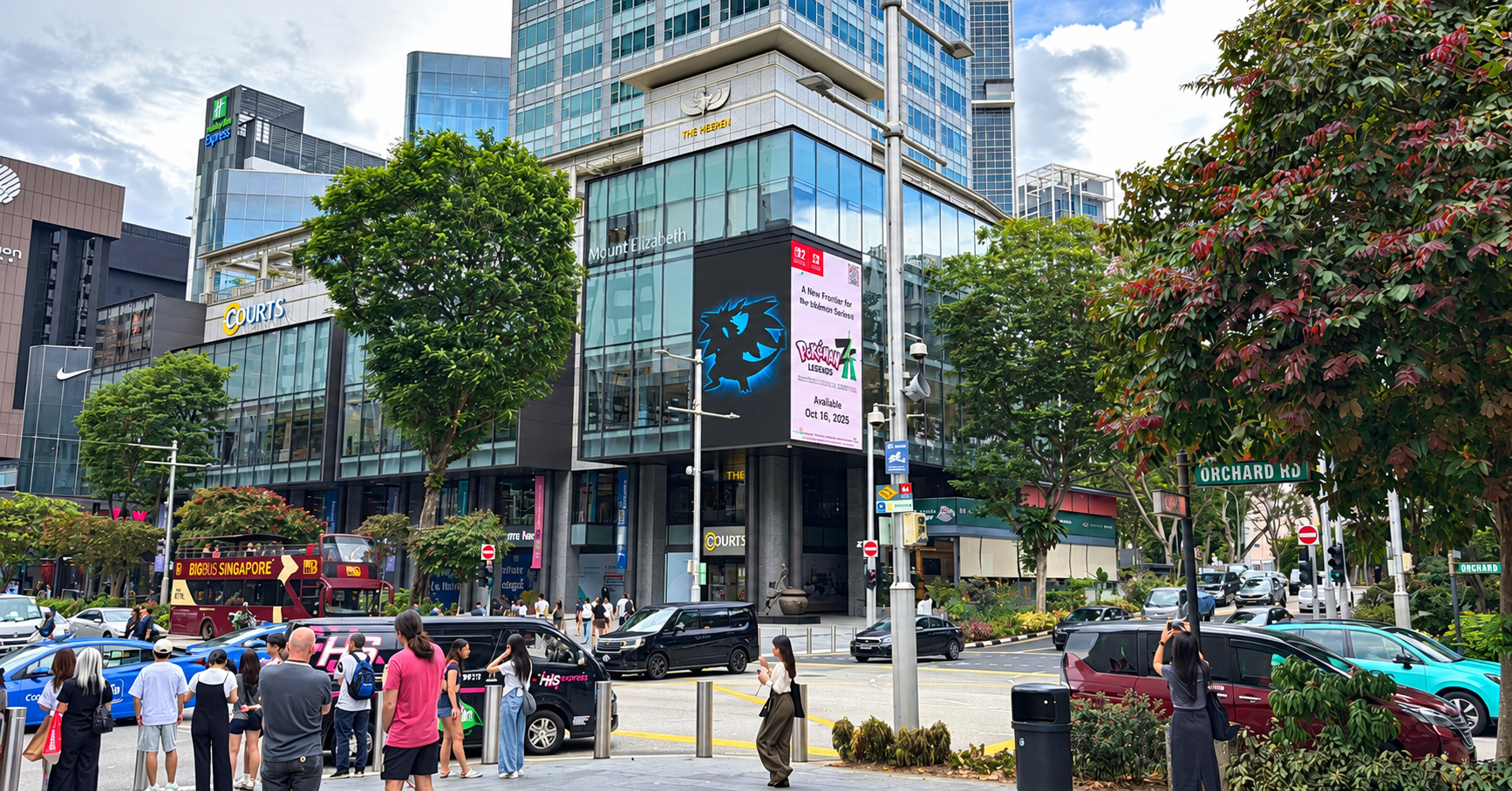
The Heeren is a strong launch advertising location in Singapore because it combines a large-format digital screen with the shopping, tourism, home furnishing and flagship retail environment of Orchard Road and Somerset. Brands can start with static or motion creative, introduce different messages throughout the campaign, and use 3D when depth and movement genuinely help audiences understand the product and to create the WOW factor.
Dyson's CameraJet launch is a good example. The product contains engineering details that are difficult to see at normal scale, so 3D can make a tiny camera, precision jet and other features larger than life. Vistar Media's Science in Motion research also found that static DOOH already produced a strong +38% uplift in aided ad recall, while 3D reached +44% and delivered the strongest top-of-mind brand awareness result. The lesson is not that every launch needs 3D. The creative format should match what the product needs to communicate.
Why Choose Orchard Road to Advertise in for a Launch in Singapore?
A global product launch has a different media job from an everyday advertising campaign.
The brand is not simply trying to generate impressions.
It is introducing something new and trying to make that arrival feel significant.
The Heeren sits along Orchard Road between the Orchard and Somerset retail areas. TPM positions its large-format digital screen as a high-impact location capable of supporting 2D, motion and 3D anamorphic creative in one of Singapore's most recognisable shopping districts.
That context matters.
People around The Heeren in Orchard Road and Somerset are already shopping, discovering products, comparing brands, visiting flagship stores, dining and spending leisure time in the city.
A global launch therefore appears in an environment where newness, premium positioning and product discovery already make sense.
The Heeren Has Already Become a Singapore Stage for Global Launches
Dyson is not the first global brand to use The Heeren when something new needs to make an impact in Singapore.
H&M x Mugler Turned a Global Fashion Launch Into an Orchard Road Moment
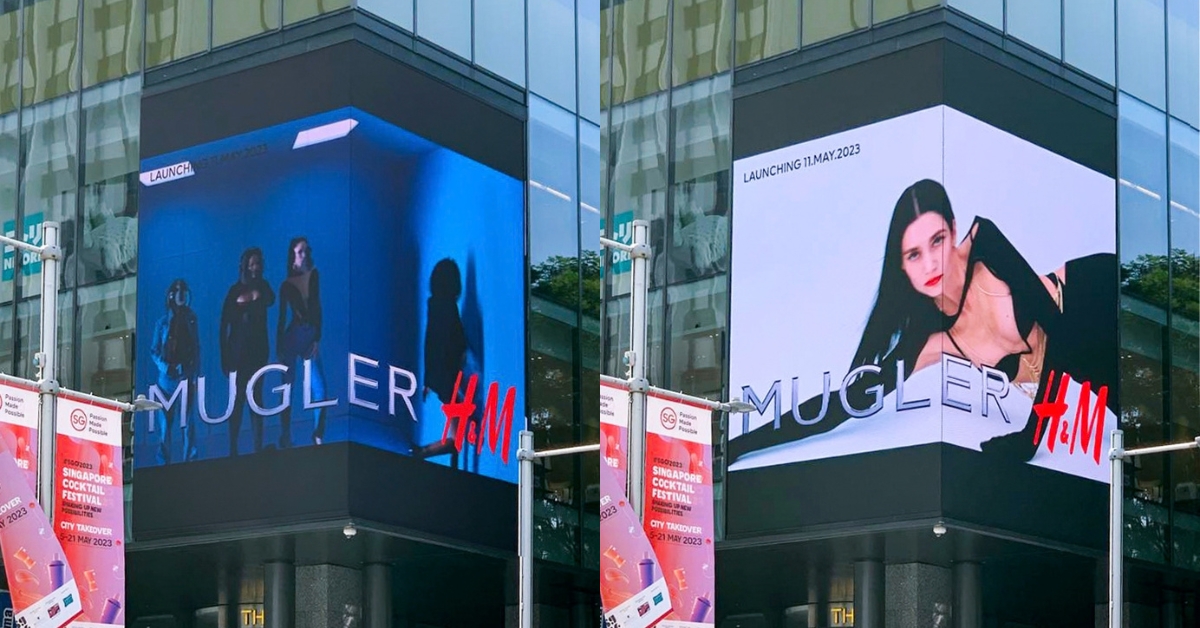
The H&M x Mugler collaboration is one of the clearest examples.
The global fashion collaboration launched in 2023, and in Singapore the campaign appeared on The Heeren LED screen during its launch week in May. The large digital canvas brought the campaign's fashion imagery into Orchard Road at the same moment the collection was generating attention internationally.
This supports making a global launch feel locally present.
Consumers in Singapore could encounter the same cultural moment physically on Orchard Road rather than only through social media, fashion press or the H&M store.
Pokémon Used The Heeren From Tease to Global Release
Pokémon Legends: Z-A provides an even more interesting launch example because the digital format was used across different stages of the campaign.
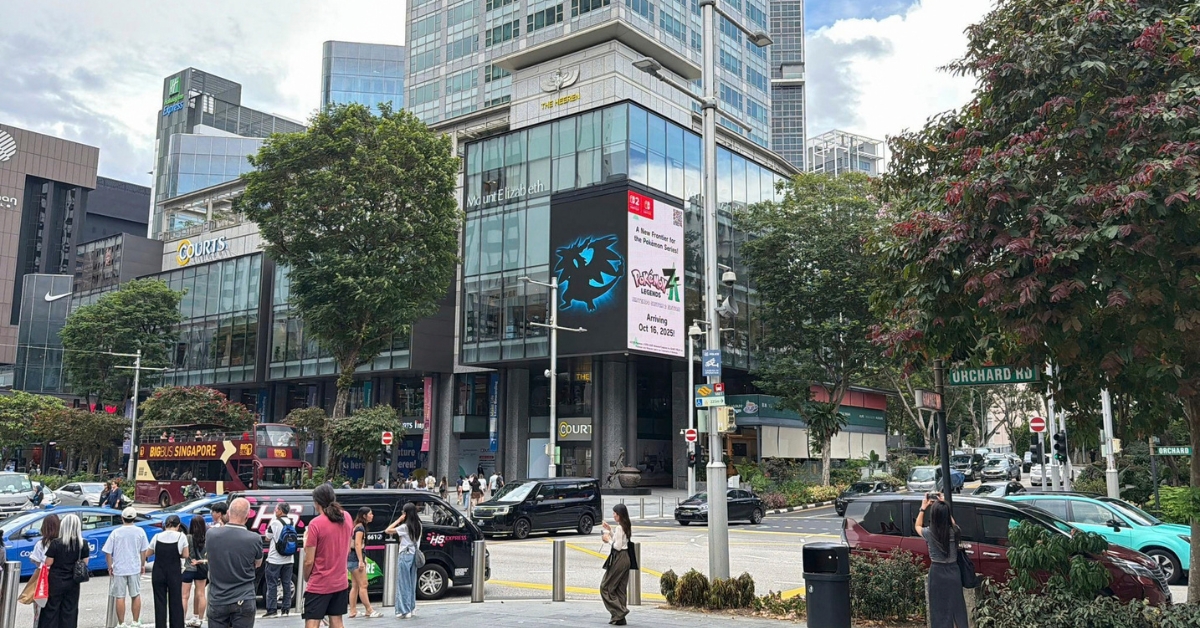
Before the official release, the Heeren creative showed a silhouette of the new Pokémon, creating curiosity and anticipation.
On the global release date, 16 October 2025, the creative changed to reveal the Pokémon in full colour. The campaign then continued across the launch weekend, keeping the release visible during a critical retail period with 7 days of visuals for a 7 day campaign.
That is DOOH being used as more than a large television screen.
The location stayed the same.
The communication job changed as the launch progressed.
Tease.
Reveal.
Release.
Continued visibility.
That creative sequencing is particularly useful for product launches because the campaign does not have to say everything on day one.
Global Campaigns Also Choose The Heeren When Singapore Needs to Feel Part of the Moment
Not every major campaign at The Heeren is a product launch.
But the list of international brands and entertainment properties that have used the screen tells us something about how the location is perceived.
Universal Music has used The Heeren for Taylor Swift, including The Life of a Showgirl, bringing a major global entertainment moment into Orchard Road.
Nike ran its global "Win on Air" campaign there, while HOKA brought its global "We Are All Born to Fly" campaign to the same screen.
During the 2025 Singapore Grand Prix, Adidas, Mastercard and Groq also activated campaigns at The Heeren, extending their Formula 1 partnerships from the global sponsorship environment into one of Singapore's most prominent retail districts.
Taylor Swift, Nike, HOKA, Adidas, Mastercard and Groq are very different brands.
But the media logic is similar.
A global campaign becomes more meaningful locally when consumers can encounter it in the physical city.
For launches, that effect is even stronger.
Digital advertising can announce something.
OOH can make its arrival feel real.
Why Dyson CameraJet Is a Natural Fit for 3D DOOH
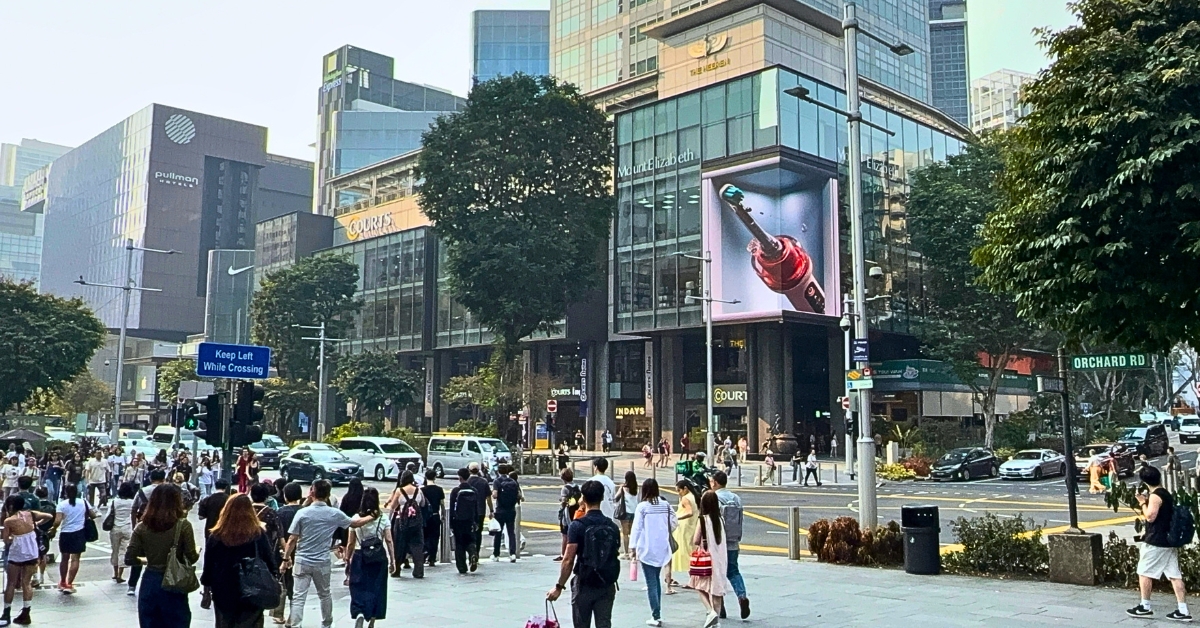
Dyson's CameraJet is an interesting product because much of its differentiation happens at a very small scale.
CameraJet contains a 100,000-pixel macro lens camera that analyses 28 images per second. Dyson's AI system identifies interdental gaps and uses a precision jet to target those spaces while brushing. The product is priced at S$699 in Singapore.
There is a lot of engineering packed into something the size of a toothbrush.
That creates a creative challenge.
How do you explain a tiny camera?
How do you show a gap between two teeth?
How do you demonstrate the precision jet while someone is walking past a screen on Orchard Road?
This is where scale becomes useful.
Big Screen. Tiny Details. Better Understood.
Put CameraJet onto a 3D-enabled screen the scale of The Heeren and those small features can become much easier to understand.
The toothbrush can rotate.
The camera can enlarge.
The gap detection can become visible.
The jet can become part of the story.
That is when 3D stops being a visual trick and starts becoming product demonstration.
For me, that is where 3D works best.
Not:
"Look, something is coming out of the screen."
But:
"Now I understand what this product actually does."
What the Science in Motion Study Tells Us About 3D DOOH
The argument for motion and 3D is becoming more evidence-based.
Vistar Media's Science in Motion study, conducted with Omnicom Media and JCDecaux, involved 7,513 respondents and compared static, subtle motion, full motion and 3D DOOH creative.
Importantly, participants were not instructed to concentrate on the advertisement. They viewed footage of a normal outdoor environment containing the DOOH creative, which more closely reflects how advertising is encountered in real life.
Static DOOH Already Performs Strongly
One of the most useful findings is that static creative on a digital screen is not a second-class option.
Static produced a +38% uplift in aided ad recall compared with the control group.
Full motion achieved +41%.
3D achieved +44%.
That relatively narrow gap tells us something important.
The screen and location themselves are already doing substantial work.
So if an advertiser has booked The Heeren but the 3D creative is still being produced, there is no reason the entire launch must automatically wait.
"We're Still Waiting for the 3D Creative"
I hear this more often than I would like.
The media is booked.
The screen is ready.
The campaign date arrives.
But:
"We're still waiting for the 3D creative."
This misses one of digital OOH's biggest advantages.
The screen does not have to wait for the creative.
If the static artwork is ready, start with static.
If motion is ready, run motion.
Then introduce the 3D execution when it is finished.
The Science in Motion findings actually make this approach more defensible. Static DOOH already delivers strong recall, while motion and 3D can add another layer of impact when they become available.
That gives global brands a much more practical launch strategy.
Where 3D Becomes the Strategic Differentiator
The Science in Motion study becomes more interesting when we look beyond simple recall.
3D delivered a +10% uplift in top-of-mind brand awareness, the highest of the formats tested, and Vistar reported it as 67% more effective at driving brand awareness than creative without motion. Full motion delivered the strongest spontaneous recall uplift at +18%.
That gives marketers a useful way to think about launch creative:
Creative format | Strong launch role | Science in Motion finding |
|---|---|---|
Static | Hero visual, launch announcement, recognition | +38% aided ad recall |
Subtle motion | Efficient animation and brand anchoring | Strong awareness performance |
Full motion | Product movement and demonstration | +18% spontaneous recall, +41% aided recall |
3D motion | Depth, product presence and launch stature | +44% aided recall, +10% top-of-mind awareness |
The research also found that the mere presence of motion can be valuable. A brand does not necessarily need an expensive, elaborate animation for movement to contribute to performance.
This is useful for launch planning because creative sophistication can increase during the campaign.
Why Digital Gives Global Launches More Flexibility
The Pokémon campaign illustrates this particularly well.
The advertiser did not have to choose one image and leave it unchanged throughout the launch.
The campaign could evolve from tease to reveal to release.
Dyson can use exactly the same principle differently.
A launch could begin with:
CameraJet is here.
Another execution could show the product.
Motion could demonstrate a feature.
Then 3D could make the camera and precision jet larger than life.
This is especially useful for global campaigns because assets rarely arrive perfectly together.
Regional approvals take time.
Local adaptations change.
3D production requires additional work.
Different markets may launch on different dates.
Digital allows the media plan to accommodate that reality instead of holding the entire campaign hostage to the final creative file.
Why Orchard Road Adds Something to a Global Product Launch
The Heeren is not simply a digital screen that happens to be large.
Its location provides context.
It sits within the Orchard and Somerset shopping corridor, surrounded by retail, restaurants, hotels and international brands. TPM describes the screen as positioned at the Orchard Road and Cairnhill Road intersection, between Somerset and Orchard MRT stations.
For premium consumer products, fashion, entertainment and technology, that environment can reinforce the positioning of the launch itself.
The H&M x Mugler collaboration benefited from appearing inside a fashion and shopping environment.
Pokémon benefited from being close to retail locations where gaming and entertainment purchases were relevant.
Adidas benefited from having its Orchard flagship store roughly 190 metres from The Heeren during its Formula 1 campaign.
That is why OOH planning should not begin with traffic alone.
The better question is:
What happens after someone sees the advertisement?
When Should a Global Brand Invest in 3D?
I would ask one question first:
Does 3D help the audience understand, desire or remember the product differently?
If a product contains engineering that is difficult to see, 3D can magnify it.
If the physical design is distinctive, 3D can exaggerate its form.
If the product performs an action, motion can demonstrate it.
If the launch only needs one powerful visual and a simple message, static may already do the job.
CameraJet passes that test because its differentiating features are literally tiny.
3D makes the invisible visible.
That is a creative reason to use the technology.
What Global Brands Can Learn From The Heeren
H&M x Mugler used The Heeren to give a global fashion launch physical presence in Singapore.
Pokémon used digital sequencing to move audiences from curiosity to global release.
Taylor Swift, Nike and HOKA used the screen to bring major international cultural and brand campaigns into Orchard Road.
Adidas, Mastercard and Groq used it to translate global Formula 1 partnerships into street-level Singapore visibility.
Dyson now has another opportunity.
Its challenge is not simply to make CameraJet look spectacular.
It is to make a technologically complex product easy to understand quickly.
The Science in Motion study reinforces the same lesson.
Do not begin by asking:
How do we make this 3D?
Begin with:
What does the audience need to understand?
Then choose static, motion or 3D according to the job.
Frequently Asked Questions About Global Product Launch Advertising at The Heeren
Why is The Heeren suitable for global product launches in Singapore?
The Heeren combines a large-format digital display with a central Orchard Road retail environment. It also supports static, motion and 3D executions, giving global brands flexibility throughout different stages of a launch.
Which global launches have advertised at The Heeren?
Past launch examples include H&M x Mugler and Pokémon Legends: Z-A. The screen has also hosted major international campaigns from Taylor Swift, Nike, HOKA, Adidas, Mastercard and Groq.
Is 3D DOOH more effective than static DOOH?
Vistar's Science in Motion research found +44% aided ad recall for 3D compared with +38% for static, while 3D also delivered the strongest top-of-mind brand awareness result. Static nevertheless performed strongly, showing that location and screen quality remain important even without motion.
Does every product launch need 3D?
No. 3D should have a communication purpose. If depth and movement help demonstrate the product, it can be powerful. If not, strong static or motion creative may be more appropriate.
Can a brand launch before its 3D creative is ready?
Yes. One of DOOH's strengths is creative flexibility. A campaign can begin with static or motion creative and introduce 3D later, subject to the media schedule and creative approvals.
Launch at The Heeren With TPM
From H&M x Mugler and Pokémon to Taylor Swift, Nike, HOKA, Adidas, Mastercard, Groq and now Dyson, The Heeren has increasingly become a Singapore stage for global brands that want their international campaigns to have a strong physical presence locally.
But a global launch should not be delayed simply because its most complex creative asset is taking longer than expected.
The Science in Motion research gives advertisers a useful framework.
Static already works.
Motion can add recall and storytelling.
3D can add depth, salience and physical presence when the product gives it something meaningful to demonstrate.
For Dyson CameraJet, that opportunity is particularly clear:
Big screen. Tiny details. Better understood.
For global brands planning a launch in Singapore, The Perfect Media Group can help determine whether The Heeren should begin with static, motion, 3D, or a planned progression across all three.
Launching in Singapore? The Heeren belongs in the plan.
Tell us about your campaign and we’ll map the right OOH mix.
Talk to a TPM Strategist