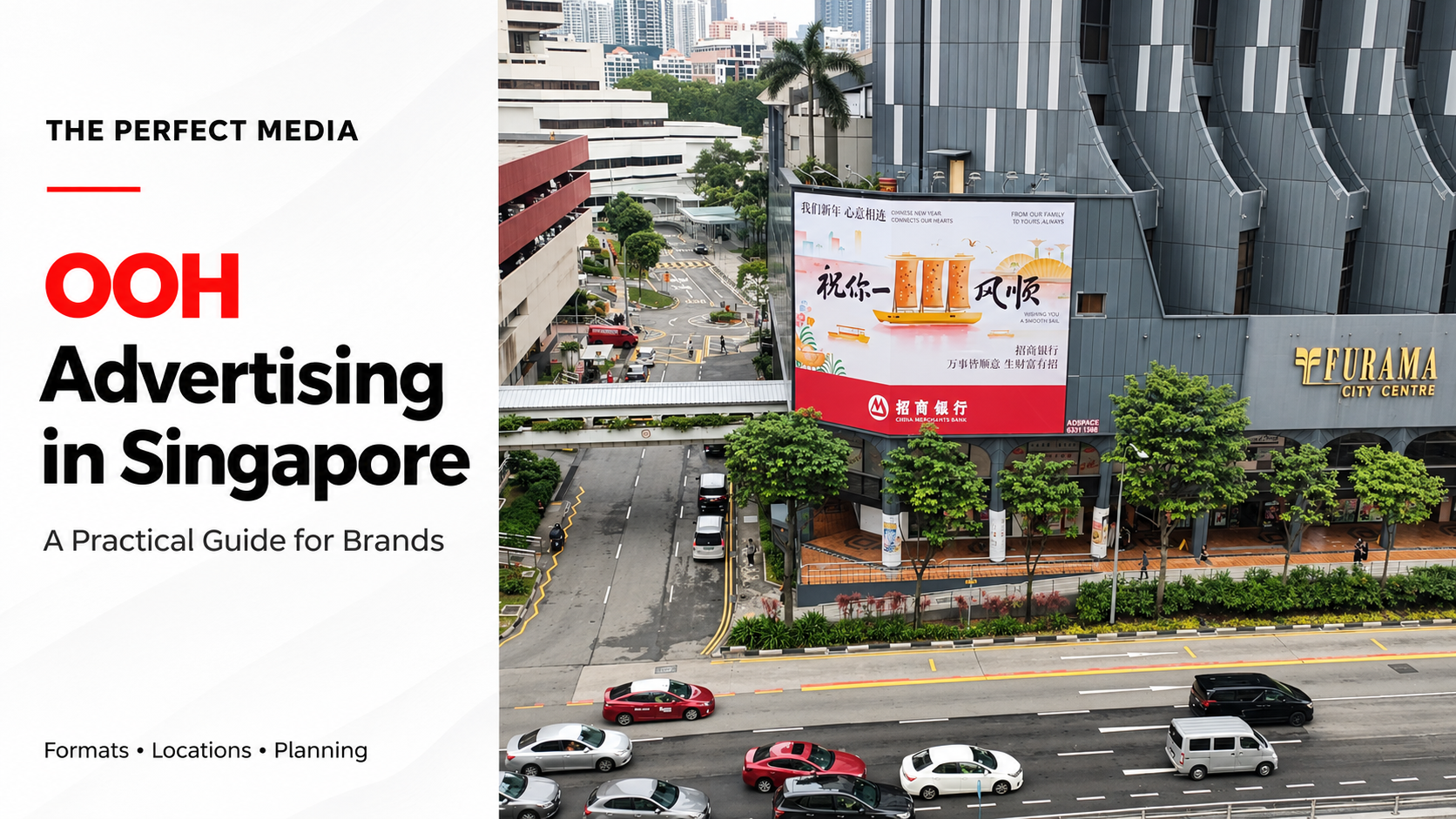
Explore OOH advertising in Singapore, from static billboards and digital screens to strategic media locations. Learn how to choose formats, plan your budget and assess measurement options for your brand’s next outdoor campaign.
Why Should Brands Choose DOOH Instead of Static Billboards?
The biggest advantage of digital out-of-home advertising is not necessarily screen size. It is what advertisers can do with the screen.
A static billboard is effective when a brand wants one clear message displayed consistently throughout a campaign.
DOOH offers additional flexibility. Creative can be updated electronically, campaign messages can change according to launch stages, and digital screens can be booked individually or as part of a wider network.
This is particularly relevant in Singapore, where brands may need to communicate with consumers across different retail, business and residential environments.
An advertiser launching a new smartphone might use animated creative to demonstrate product features on Orchard Road, while running a simplified promotional message across digital screens in shopping districts and commercial centres.
The same campaign could potentially feature different creatives before and after its official launch.
DOOH allows advertisers to match their creative, location and advertising schedule to different campaign objectives without replacing physical billboard materials.
DOOH vs Static OOH: What Are Advertisers Actually Paying For?
Buying consideration | Static billboard | Digital OOH |
Advertising exposure | Continuous display of a fixed creative with lighting options | Often rotating advertising slots |
Creative flexibility | Physical replacement required | Electronic creative updates |
Animation and video | Not supported | Supported on suitable screens |
3D effects | Limited to physical installations using cut out and sculptures | Anamorphic 3D possible on compatible screens |
Campaign sequencing | Separate physical executions | Multiple creatives can be scheduled |
Buying options | Fixed-location bookings | Direct bookings, networks and eligible programmatic inventory |
Production | Printing, installation and removal | Digital adaptation, animation and testing |
When Static Billboards Are Still the Better Choice
Static advertising remains a suitable option for simple and consistent messages.
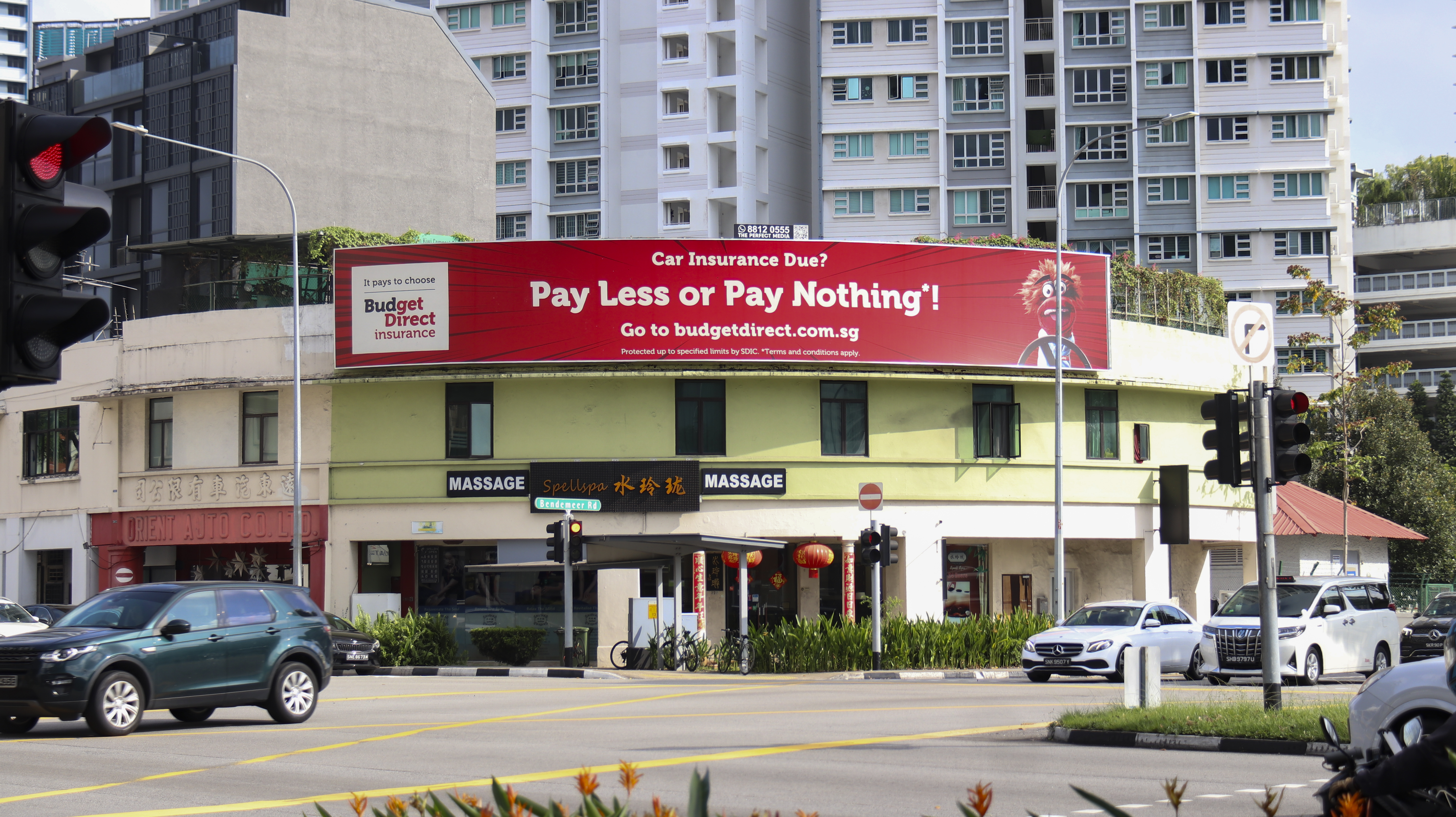
For example, a financial institution promoting an interest-bearing savings product or a telecommunications brand advertising a fixed-price plan may benefit from sustained visibility of one straightforward message. One of clients targeting automotive such as Budget Direct Insurance specifically needed static billboards to ensure drivers are still able to read their bold offer at a distance in front of traffic junctions.
There may be little benefit in paying for animation if movement does not improve the communication.
When DOOH Becomes the Better Investment
Digital advertising becomes more useful when the brand needs to demonstrate a product, communicate multiple messages or change its creative during a campaign.
An entertainment advertiser can move from teaser to release-date messaging. A retailer can change promotional artwork. A technology company can use video to highlight product features.
The decision should begin with what the audience needs to understand, not simply whether the screen supports animation.
What DOOH Capabilities Matter Most to Advertisers?
1. Creative Flexibility and Campaign Sequencing
DOOH enables brands to plan different creative messages without physically changing advertising materials.
For example, a product launch may follow four stages:
Teaser → Reveal → Launch → Sustain
Each stage has a different communication purpose.
A teaser builds anticipation. The reveal introduces the product. The launch creative confirms availability. The sustain phase reinforces the product's benefits.
This flexibility is particularly valuable for brands coordinating launches across multiple markets or waiting for final creative approvals.
2. Animation, Video and Product Demonstration
Movement can help communicate products whose features are difficult to explain in a static image.
A beauty brand might use a short animation to demonstrate a product texture. A technology advertiser could enlarge a device's components. A fashion advertiser could use movement to show how a collection looks when worn.
However, outdoor creative must work within short viewing opportunities.
A digital advertisement should communicate its central idea quickly, with clear branding and visuals that remain understandable without audio.
3. Anamorphic 3D Creative
Anamorphic 3D uses carefully designed perspectives to create the illusion of depth on a suitable digital screen.
It can be useful for product demonstrations, major announcements and campaigns where scale or movement helps explain a product.
For example, Dyson's CameraJet electric toothbrush creative at The Heeren illustrates how a small product's engineering features can be presented at a much larger scale.
The value lies in making product details easier to understand, not simply creating a visual spectacle.
See TPM's Orchard Road product launch case studies.
Not every digital screen supports the same 3D creative. Viewing angle, screen geometry, resolution and production requirements must be confirmed for each location.
TPM's current Singapore network specifications identify Chinatown Point, Orchard Gateway, Alexandra Grand Junction and Chinatown Courtyard as anamorphic-ready locations.
4. Advertising Rotation and Scheduling
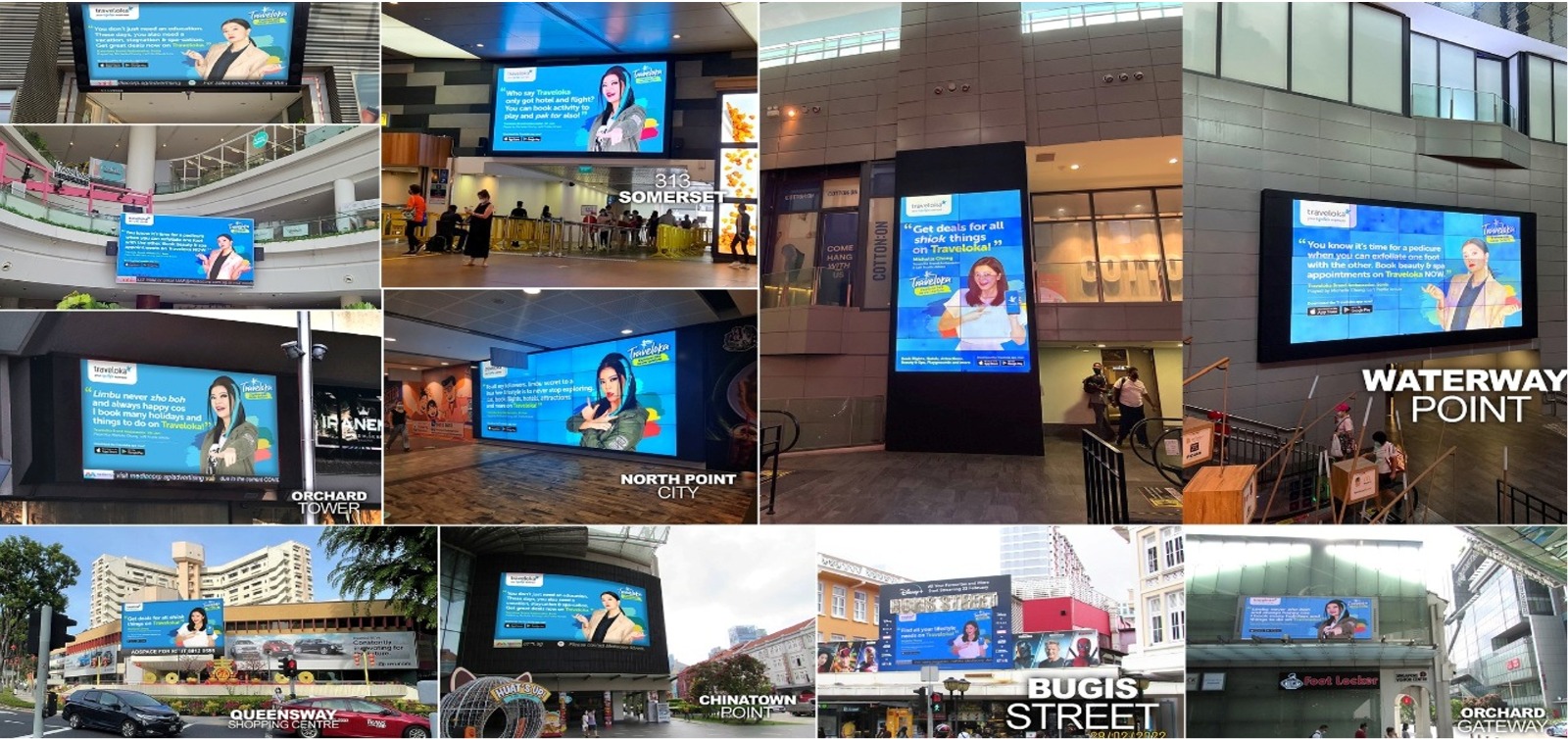
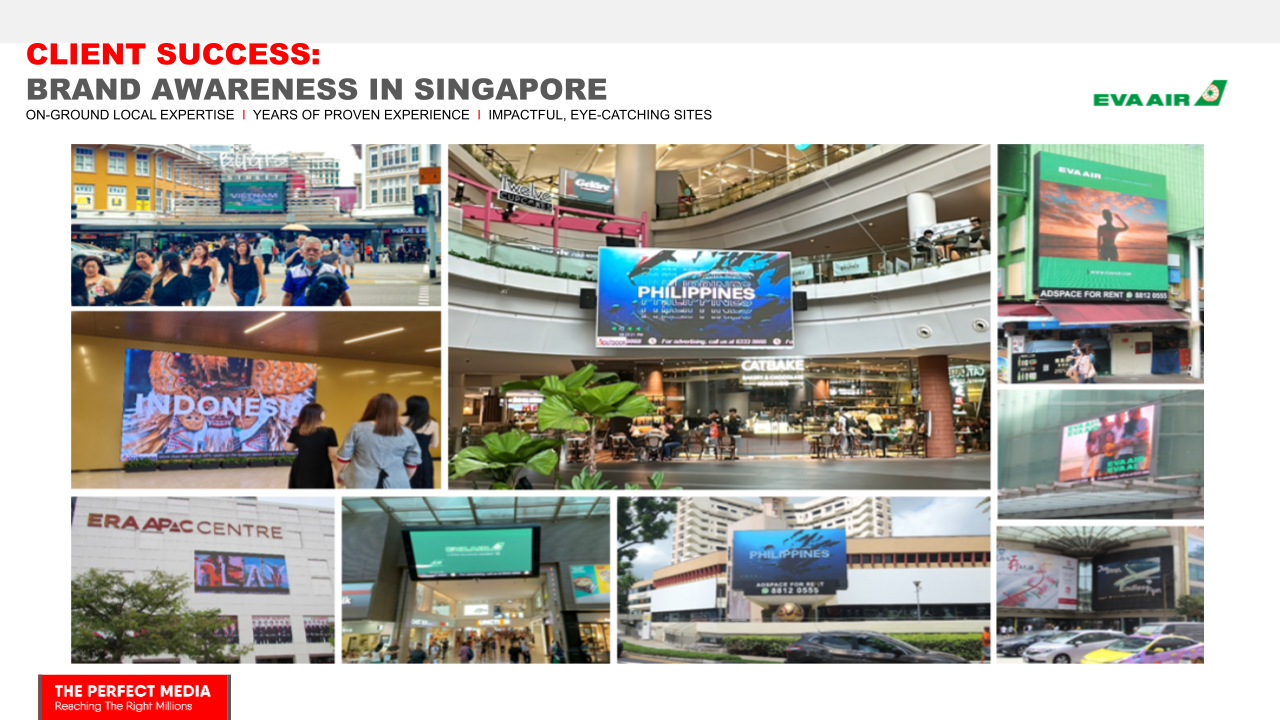
Unlike a traditional static billboard, many DOOH screens display advertisements from multiple brands in rotation. Advertisers such as EVA air used the OOH network of digital screens in 8 malls to feature both their business class travel creative and another vibrant one targeting tourists with stunning visuals of popular tourist destinations. Traveloka split their advertising investment between 2 campaigns - one of them featuring brand ambassador Michelle Cheong and another one that is offer based coinciding their brand anniversary.
Buyers should understand the advertising duration, number of spots per hour, screen operating hours and share of voice.
For example, TPM's current DOOH network packages specify an entitlement of 280 to 720 advertising spots per day per screen depending on which screens.
At a standard 15-second duration, this represents five minutes of scheduled advertising per hour on each screen.
The actual exposure opportunity also depends on operating hours, audience movement and the screen's location.
One Premium LED Screen or Multiple DOOH Locations: Which Should Brands Choose?
A flagship digital screen and a multi-location DOOH network perform different advertising jobs.
A flagship location concentrates the advertising message within a particular environment.
A network distributes the campaign across several locations and audience catchments.
Campaign objective | Single flagship screen | Multi-location DOOH network |
Major product launch | Strong fit | Useful for extending the launch |
Premium brand positioning | Strong fit | Depends on site selection |
Nationwide brand awareness | Limited geographic coverage | Broader geographic coverage |
Retail and promotional campaigns | Useful near flagship stores | Useful across multiple shopping catchments |
Creative-led product demonstration | Strong fit on suitable screens | Depends on screen capability |
Repeated brand presence | Concentrated in one location | Distributed across several locations |
Budget allocation | Concentrated investment | Spread across a network package |
When a Flagship Digital Screen Is Appropriate
A major fashion, entertainment or technology launch may benefit from a prominent digital screen in a premium retail environment.
The Heeren on Orchard Road is one example.
Its location and large-format digital capabilities have supported international fashion and entertainment campaigns, including H&M x Mugler, Pokémon Legends: Z-A and most recently, Dyson CameraJet™ electric toothbrush.
These campaigns demonstrate how digital creative can support visual storytelling and launch sequencing.
Advertisers can explore why global brands choose The Heeren for product launches in Singapore.
When a Multi-Location DOOH Network Makes More Commercial Sense
A brand targeting consumers across Singapore may benefit from distributing its advertising across shopping malls, neighbourhoods, commercial buildings and transport-linked destinations.
For example, an FMCG advertiser promoting a new beverage may want visibility among shoppers in Chinatown and Bugis, office workers in Paya Lebar and Changi Business Park, and families visiting Toa Payoh or Alexandra.
A network strategy creates opportunities to reinforce the same message within different consumer environments.
The objective is not simply to purchase more screens. It is to select complementary locations that serve the wider campaign.
Working with MediaCorp Singapore DOOH Network: From8 and 10 Mall Locations
The Perfect Media Group works with MediaCorp Singapore offers bundled digital outdoor advertising across multiple shopping, commercial and commuter environments that includes some of our exclusive screens.
Its Singapore network is structured around six-, eight- and ten-location options, allowing advertisers to evaluate coverage against their campaign objectives and budgets.
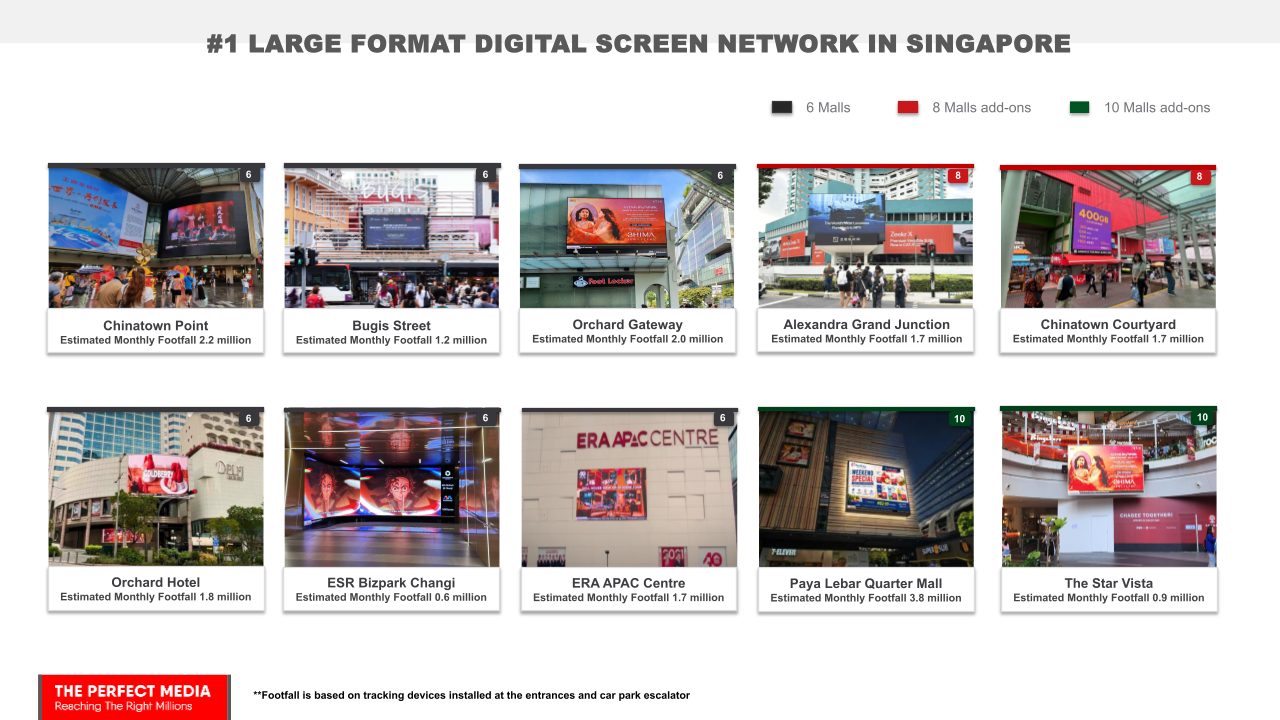
The Core Six-Location Network
Location | Audience environment | Commercial opportunity |
Chinatown Point | Chinatown retail, tourism and MRT-connected activity | Retail, finance, lifestyle and consumer brands |
Bugis Street | Shopping, youth-oriented retail and visitor activity | Fashion, entertainment, beauty and consumer products |
Orchard Gateway | Somerset and Orchard Road shopping corridor | Retail launches, lifestyle and technology |
Orchard Hotel | Orchard Road hotel and premium retail environment | Travel, lifestyle and premium consumer categories, subject to site restrictions |
ESR BizPark @ Changi | Business park and EXPO-linked commuter activity | Corporate services, technology, F&B and consumer products |
ERA APAC Centre, Toa Payoh | Established residential town centre, transport and commercial activity | Consumer services, retail and neighbourhood awareness |
The six-location offering combines established shopping districts with decentralised commercial and residential catchments.
For advertisers, this provides an alternative to concentrating the entire campaign within the CBD or Orchard Road.
Expanding to Eight Locations: Alexandra and Chinatown Courtyard
The eight-location package adds two distinct advertising environments.
Alexandra Grand Junction, near Queensway Shopping Centre and IKEA Alexandra, offers visibility within a major road junction and surrounding retail catchment. The location may be particularly relevant for automotive, home-related, consumer electronics and lifestyle advertisers.
Chinatown Courtyard adds a pedestrian-facing digital environment associated with Chinatown's retail, dining and community activity.
These additions extend the network's presence beyond conventional shopping mall screens by incorporating distinct roadside and pedestrian environments.
Expanding to Ten Locations: PLQ Mall and The Star Vista
The ten-location option adds two commercially relevant destinations.
Paya Lebar Quarter (PLQ) Mall connects retail and dining activity with an integrated business district and Paya Lebar MRT Interchange. This creates opportunities for advertisers targeting office workers, commuters, nearby residents and shoppers.
The Star Vista, beside Buona Vista MRT, serves a combination of retail, dining, entertainment and audiences associated with the nearby one-north business and education catchment.
These additions broaden the network across Singapore's eastern and western commercial corridors.
For brands targeting working professionals, the expansion is particularly relevant as employment activity extends beyond the traditional CBD into Paya Lebar, Changi Business Park, one-north and other decentralised business locations.
The commercial value of a ten-location network lies in connecting different audience environments through one coordinated campaign, rather than purchasing ten unrelated digital screens.
The availability of the ten-location package, including PLQ Mall and The Star Vista, should be confirmed for the intended campaign period.
How Should Advertisers Evaluate DOOH Network Packages?
When comparing digital screen networks, advertisers should assess more than the total number of locations.
Advertising Frequency and Share of Voice
The first question is how frequently the advertisement will appear.
A package of ten screens with a limited number of daily spots is not directly comparable to a smaller network with higher advertising frequency.
Request the number of scheduled spots per hour, standard creative duration and operating hours.
Screen Location and Audience Relevance
Different network locations serve different consumer environments.
Orchard Gateway may support fashion and lifestyle messaging, while ESR BizPark @ Changi offers a business-park environment.
PLQ Mall and The Star Vista connect advertising with retail activity near major transport interchanges and decentralised commercial areas.
Choose locations according to the target audience rather than simply maximising screen count.
Creative Adaptation Across Different Screens
A network may contain landscape, square and unusually proportioned LED screens.
Creative materials should be adapted to each display's technical specifications.
One video file may not provide an equally effective viewing experience across every screen.
Package Flexibility
Advertisers should confirm whether locations are fixed within the package or can be selected individually.
They should also check advertising frequency, campaign dates, production charges and any applicable restrictions.
A network package may offer commercial efficiencies, but only when the locations and exposure match the campaign brief.
How Much Does DOOH Advertising Cost in Singapore?
DOOH advertising prices vary according to location, screen specifications, campaign duration, advertising frequency and creative requirements.
Advertisers may purchase individual screens, negotiated network packages or eligible programmatic inventory.
TPM's Singapore DOOH offering includes individual screen bookings and promotional bundles covering six, eight or ten locations.
The most useful comparison is not simply the total media price, but what the advertiser receives.
Pricing factor | What to evaluate |
Location | Audience fit and commercial environment |
Screen format | Display size, visibility and technical capabilities |
Advertising rotation | Number of spots and share of voice |
Operating hours | Daily scheduled advertising window |
Campaign duration | Total booked period |
Creative production | Digital adaptation, animation or 3D requirements |
Geographic coverage | Individual site versus bundled network |
Measurement | Standard delivery reporting versus additional audience research |
Should Advertisers Compare DOOH Using CPM?
Cost per thousand impressions (CPM) can support comparisons when audience estimates are credible and the measurement methods are comparable.
CPM = Media cost ÷ Estimated impressions × 1,000
However, traffic counts, screen impressions, estimated opportunities to see and unique audience reach are different measurements.
A lower estimated CPM does not automatically mean a better advertising investment.
The more important consideration is whether the selected media reaches the appropriate audience with sufficient visibility and advertising frequency.
What Is Programmatic DOOH (pDOOH)?
Programmatic digital out-of-home, or pDOOH, allows advertisers to buy eligible digital screen inventory through technology platforms.
Unlike a conventional fixed-location booking, programmatic buying may offer more flexible scheduling, activation and reporting.
Platforms operating in this category include Vistar Media, Broadsign and Perion's DOOH solutions.
When Should Brands Consider pDOOH?
Programmatic buying may be useful when advertisers want to activate campaigns around specific times, dates or contextual conditions.
A beverage advertiser, for example, may explore weather-responsive messaging. A retail advertiser may prefer to concentrate advertising around selected shopping periods.
The actual options depend on the screens available through the platform and the data or activation features supported.
Is pDOOH Better Than Buying Directly?
Not necessarily.
A brand seeking guaranteed presence at a specific premium screen may prefer a direct media booking.
An advertiser requiring flexible scheduling across eligible digital inventory including online digital advertising may find programmatic buying more appropriate.
An OOH agency can also combine direct bookings and pDOOH within a coordinated campaign.
The best buying method is the one that delivers the required locations, exposure, flexibility and commercial certainty.
Beyond DOOH: Independent Audience Measurement and Digital Media Integration
DOOH is increasingly evaluated as part of a broader advertising strategy rather than an isolated media purchase.
Advertisers need to understand not only where their creative appeared, but also what can reasonably be measured about the audience and campaign.
Proof-of-Play and Campaign Delivery
Proof-of-play reporting provides records of digital advertisement delivery.
This helps advertisers assess whether the purchased advertising slots ran according to the agreed schedule.
Proof-of-play does not establish how many individuals actually noticed or watched the advertisement.
Independent Audience Measurement
The Perfect Media Group can arrange independent audience measurement for selected OOH and DOOH campaigns.
Depending on the methodology and available data, reports may include estimated audience reach, frequency, demographic profiles, consumer interests and mobility patterns.
Such information can help advertisers evaluate individual screens or compare media packages.
Retail Footfall Attribution
For suitable campaigns, independent measurement may also examine store visitation among audiences assessed as exposed to the advertisement compared with a control group.
TPM's current media presentation includes a Zeekr campaign at Queensway Shopping Centre, reporting that the measured exposed group was 2.69 times as likely to visit the showroom as the comparison group.
This is a campaign-specific reported result, not a guaranteed outcome for other advertisers. Its research methodology and supporting report should be reviewed before using the figure as a general performance benchmark.
DOOH and Mobile Advertising: A Complementary Strategy
TPM can also collaborate with digital media agencies and programmatic partners to develop coordinated DOOH, pDOOH and mobile advertising campaigns.
For example, an advertiser might combine DOOH screens across retail catchments with complementary mobile media aimed at reinforcing the campaign message.
This allows outdoor advertising to form part of a wider marketing plan spanning physical locations and personal devices.
Audience targeting and attribution must be supported by suitable data, measurement methods and applicable privacy requirements.
The value of integrated media planning is not simply adding another channel. It is creating a consistent communication strategy across the environments where audiences encounter a brand.
What Creative Specifications Should Advertisers Check Before Booking DOOH?
DOOH creative requirements can vary considerably between screens.
Advertisers should confirm the technical specifications before production begins.
Standard Video Duration
TPM's current network specifications generally use 15-second advertising spots as the standard booking reference.
Non-standard durations may affect the number of scheduled spots.
Resolution and Screen Format
Creative materials must be prepared for each screen's resolution and aspect ratio.
A landscape creative may need adaptation for a square or unusually shaped display.
Audio and Animation
Audio is not available at every outdoor location.
The creative should remain understandable without sound, especially for roadside and high-movement environments.
Animation should reinforce the main message rather than distract from it.
3D Technical Compatibility
Anamorphic 3D requires creative designed for the actual screen and its viewing geometry.
Production requirements may include specialised animation, perspective testing and format-specific rendering.
Booking and Creative Deadlines
For its standard network, TPM's current presentation indicates advance booking and creative submission requirements.
More complex executions may need additional production, testing and approval time.
Advertisers should confirm deadlines before committing to launch dates.
When Should Brands Choose One LED Screen, a DOOH Network or pDOOH?
The most important diagnostic question is:
Does the campaign require one strong brand moment, repeated visibility across multiple locations or flexible data-informed activation?
Campaign requirement | Recommended approach |
Major international launch | Flagship LED screen |
Product feature demonstration | Animated or 3D-capable screen |
Nationwide consumer awareness | Multi-location DOOH network |
Retail visibility across several districts | Network with relevant retail catchments |
Flexible scheduling | Eligible pDOOH inventory |
Flagship launch followed by wider awareness | Premium screen combined with a network |
Simple continuous brand message | Consider static OOH |
A hypothetical consumer electronics campaign might begin with a flagship digital launch, followed by a network campaign around retail and commuter locations.
Alternatively, an established consumer brand introducing a straightforward promotion might prioritise the network from the beginning.
There is no need to purchase a premium 3D execution if the campaign message can be communicated effectively through standard digital artwork.
The media strategy should reflect the communication objective, not the perceived sophistication of the technology.
Frequently Asked Questions About DOOH Advertising in Singapore
1. How much does DOOH advertising cost in Singapore?
DOOH advertising costs depend on screen location, advertising frequency, display size, duration and creative requirements. Advertisers can compare individual LED screens with network packages covering multiple Singapore locations. Quotations should clearly specify airtime, operating hours, production requirements and applicable charges.
2. What is the difference between static OOH and DOOH?
Static OOH generally provides continuous display of a fixed advertisement, while DOOH uses electronic screens that can support multiple creatives, animation and scheduled content changes. Many digital screens rotate advertisements between brands.
3. How long should a DOOH campaign run?
Campaign duration depends on the objective and available booking arrangements. A launch campaign may concentrate activity around a release date, while a broader awareness campaign may require several weeks of sustained visibility. Advertisers should confirm minimum durations and screen availability.
4. Can advertisers get exclusive use of a DOOH screen?
Yes! Digital screens may offer exclusive advertising or higher share-of-voice arrangements, depending on availability and commercial conditions. Standard network packages often use rotating advertising slots. Advertisers should confirm exposure and exclusivity in the booking agreement including paying for higher share of voice or a premium for exclusivity.
5. What is the advantage of booking multiple DOOH screens?
A multi-location DOOH campaign allows a brand to distribute its message across different retail, business and commuter environments. This can be useful for advertisers seeking broader geographic presence rather than concentrating their media investment in one landmark location.
6. Can DOOH campaign performance be measured independently?
Yes. Independent audience measurement can be arranged for suitable campaigns using available audience and mobility data. Reports may include estimated reach, frequency, audience characteristics and retail visitation analysis. The methodology and measurement limitations should be reviewed before drawing conclusions about campaign performance.
Plan Your DOOH Campaign in Singapore with The Perfect Media Group
DOOH advertising gives brands the flexibility to create memorable campaigns, adapt their messages and build visibility across Singapore's key shopping, business and commuter locations.
From a high-impact 3D LED screen to a coordinated network of digital displays, advertisers can choose the right combination of creative formats, locations and audience reach to support their marketing objectives.
With greater scheduling flexibility, digital campaign integration and independent audience measurement, DOOH offers brands more opportunities to maximise the value of their advertising investment.
The Perfect Media Group offers digital outdoor advertising planning, individual LED screen bookings, multi-location DOOH network packages, creative coordination and access to independent audience measurement services.
Planning a DOOH campaign in Singapore?
Contact The Perfect Media Group to compare individual LED screens with network media, review creative specifications and explore a coordinated DOOH campaign suited to your audience, budget and marketing objectives. With 2026 coming to a close, ping us for last minute offers of our advertising packages that can deliver the RIGHT audience to increase your brand’s year end sales and performance.
Tell us about your campaign and we’ll map the right OOH mix.
Talk to a TPM Strategist