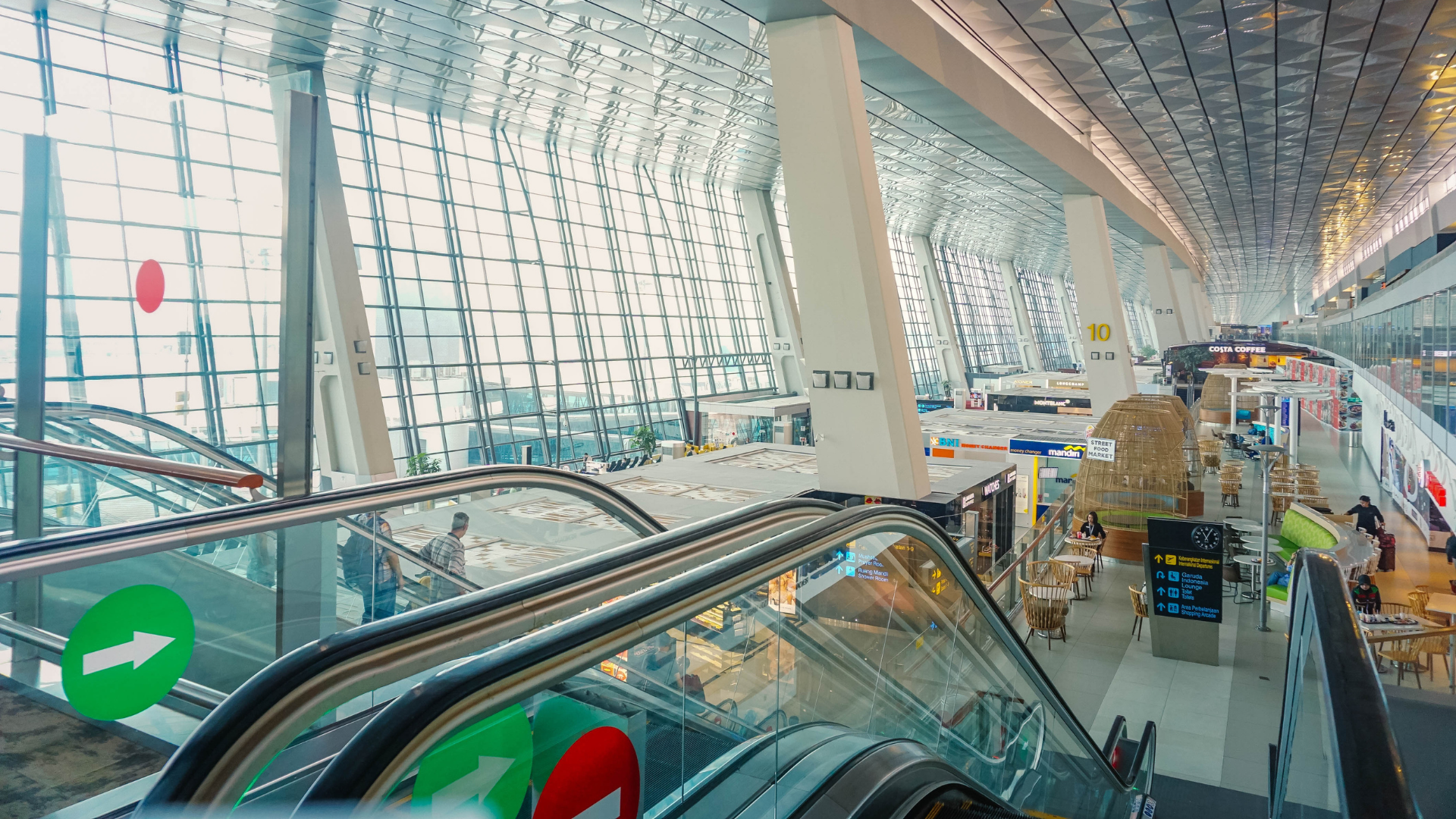
Airports put your brand in front of travellers with time to look. Explore advertising formats, audiences and planning tips for airport campaigns across ASEAN, from arrival halls to departure gates.
ASEAN Airport Advertising Guide: Comparing Southeast Asia's Major OOH Hubs
For brands expanding across Southeast Asia, few media environments deliver the concentration of high-value audiences that airports do. Every major aviation hub in the region — from Changi and Soekarno-Hatta to Tan Son Nhat and Kuala Lumpur International — funnels millions of business travellers, regional tourists, and upwardly mobile domestic passengers through terminals daily. In a region where digital advertising is increasingly skipped, muted, or blocked, airport media remains one of the few formats that commands attention. This guide is designed to help regional marketing managers and media planners understand the landscape, the differences between markets, and how to build a multi-hub OOH strategy across Southeast Asia's busiest airports.
Why Advertise at Airports in Southeast Asia?
Southeast Asia's aviation sector has rebounded strongly, with rising air connectivity creating opportunities for airport advertising across the region. According to Airports Council International Asia-Pacific & Middle East (ACI APAC & MID), ASEAN airports handled more than 700 million passengers in 2025, reflecting the scale of domestic and international air travel across Southeast Asia. For advertisers, major aviation hubs such as Singapore Changi, Jakarta Soekarno-Hatta (CGK), Bangkok Suvarnabhumi and Kuala Lumpur International Airport (KLIA) offer opportunities to reach distinct business, leisure and regional travel audiences through Out-of-Home (OOH) and Digital Out-of-Home (DOOH) advertising.
What makes these environments particularly attractive for out-of-home advertising is not just the volume — it is the quality and mindset of the audience. Airport dwellers are, by definition, stationary, time-rich, and receptive. Dwell times in major ASEAN terminals average between 90 minutes and 3 hours, creating extended windows for brand messaging to land. These dwell time varies by terminal, airline, security process, passenger type and measurement method.
Beyond dwell time, the demographic profile at major Southeast Asian airports skews toward audiences that are difficult to reach efficiently anywhere else: frequent business flyers, affluent leisure travellers, senior executives in transit between regional offices, and digitally active millennials making cross-border purchases. For financial services, luxury, technology, and travel brands in particular, no other OOH format concentrates this profile so precisely.
There is also a psychographic dimension to consider. Passengers at airport hubs are often in a moment of transition — between cities, between work modes, or between countries. Research consistently shows that consumers in transit are more open to discovery, more likely to recall brand messaging, and more inclined to act on aspirational advertising than when they are in a habitual daily commute. This is the environment brands should be capitalising on.
ASEAN Airport Advertising: Market-by-Market Comparison
Singapore — Changi Airport
Singapore Changi remains the undisputed benchmark for premium airport advertising in Southeast Asia. Consistently rated among the world's best airports, Changi's terminals attract a disproportionate share of business-class travellers, transit passengers connecting between continents, and high-net-worth visitors entering Singapore. Singapore Changi Airport is one of Southeast Asia's major international aviation hubs, recording 69.98 million passenger movements in 2025, with Indonesia ranking as its second-largest passenger market after China, according to Changi Airport Group. Among Changi's five busiest international routes, Jakarta ranked third and Denpasar (Bali) fourth, alongside Kuala Lumpur, Bangkok and Hong Kong. Singapore's connectivity with Indonesia expanded further in 2025 with new direct links to Labuan Bajo, Padang and Semarang, strengthening travel connections beyond Jakarta and Bali.
For advertisers, these routes create opportunities to engage Indonesian and international travellers moving between Singapore and Indonesia for business, tourism and leisure.
Singapore's broader OOH regulatory environment is well-structured, with clear permitting processes managed through the Urban Redevelopment Authority (URA) for outdoor media in the Singapore city and airport-specific protocols through the Civil Aviation Authority of Singapore (CAAS) and Changi Airport Group (CAG). The Singapore Airport advertising inventory is commercially managed through concession arrangements. For brands already running campaigns in Singapore's city-centre locations — such as along Orchard Road or in the CBD — integrating airport media creates a coherent city-wide brand surround that reinforces messaging from street to terminal. Hyperlink: See The Perfect Media website for listing of our Singapore city media locations
Indonesia — Soekarno-Hatta and Beyond
Indonesia presents the most complex and most rewarding airport media opportunity in Southeast Asia. The archipelago's geography means aviation is not a luxury — it is infrastructure. Indonesia has over 30 commercial airports of significance, with Soekarno-Hatta International (CGK) in Jakarta handling the largest volume. But Ngurah Rai in Bali, Juanda in Surabaya and Sultan Hasanuddin in Makassar each serve distinct and commercially important audience segments.
What differentiates TPM's position in Indonesia specifically is direct access. Through established relationships with PT Angkasa Pura which has merged in Sept 2024 and now branded as InJourney Airports — The Perfect Media Group works directly as a media owner and media partner, on top of being a reseller and agency. This flexible working style means faster negotiations, cleaner contracts, more flexible campaign structuring, and genuine intelligence about available inventory. For brands planning campaigns across multiple Indonesian airports simultaneously, this direct-access model removes significant friction from the planning process.
Indonesian airport audiences vary meaningfully by location. Soekarno-Hatta's Terminal 3 skews heavily toward corporate and government travellers, while Ngurah Rai in Bali draws a leisure-heavy mix of international tourists and regional visitors — an important distinction when planning creative strategy. Campaigns that perform well for a financial services brand at CGK may need significant adaptation for Bali's tourism-oriented audience.
Vietnam — Tan Son Nhat and Noi Bai
Vietnam's two primary international airports — Tan Son Nhat in Ho Chi Minh City and Noi Bai in Hanoi — together handle the bulk of Vietnam's international passenger traffic. Vietnam's aviation market is one of the fastest-growing in ASEAN, driven by a rising middle class, strong domestic tourism, and increasing inbound business travel tied to manufacturing and tech investment. The advertising environment inside Vietnamese airports has evolved considerably, with digital OOH screens now available in both terminals alongside more traditional static formats.
Regulatory considerations in Vietnam require working with licensed local entities, which makes having an on-the-ground partner — rather than attempting to navigate permits and vendor relationships remotely — essential. TPM's Vietnam subsidiary provides exactly this capability, particularly for brands seeking to coordinate airport campaigns with broader city-level OOH activity in Ho Chi Minh City or Hanoi.
Other Significant ASEAN Hubs
Kuala Lumpur International Airport (KLIA) and klia2 are Southeast Asia's major aviation and transit hubs, recording 63.3 million passenger movements in 2025, an increase of 10.8% year-on-year, according to Malaysia Airports. KLIA was also ranked the world's fourth most connected international airport and Asia Pacific's most connected megahub in 2026 by aviation analytics company OAG. Its regional connectivity includes the Kuala Lumpur to Singapore route, which offered approximately 5.6 million scheduled airline seats in 2025, making it the world's third-busiest international air route by seat capacity. Indonesia is another important market, with direct connections between Kuala Lumpur and Jakarta, Bali (Denpasar), Medan, Surabaya, Yogyakarta, Makassar and Labuan Bajo, supporting business travel, tourism and regional connections. KLIA's connections with Indonesia are supported by major airlines including AirAsia, Indonesia AirAsia, Batik Air and Malaysia Airlines, serving key destinations such as Jakarta, Bali and Medan. With flights operating through both KLIA Terminal 1 and Terminal 2, these routes create opportunities for airport OOH and DOOH advertisers to reach travellers moving between Malaysia and Indonesia.
Verified 2025 passenger figures
Indonesia's Directorate General of Civil Aviation reports these passenger volumes on routes connecting Indonesian airports with Kuala Lumpur:
Jakarta to Kuala Lumpur: 2.86 million
Bali to Kuala Lumpur: 1.72 million
Medan to Kuala Lumpur: 1.05 million
For media planners, understanding airline networks, terminal allocations and passenger flows is important when selecting advertising locations targeting Indonesian business and leisure travellers.
Top 5 Indonesian Cities Connected to KLIA, Kuala Lumpur
Based on current tracked direct-flight frequencies from Kuala Lumpur International Airport (KUL), the five leading Indonesian destinations are:
Rank | Indonesian city | Airport Code/ Key Airlines |
1 | Jakarta | CGK |
2 | Denpasar, Bali | DPS AirAsia, Batik Air Malaysia, Malaysia Airlines |
3 | Medan | KNO AirAsia, Indonesia AirAsia, Batik Air Indonesia, Malaysia Airlines |
4 | Surabaya | SUB |
5 | Pekanbaru | PKU |
For advertisers, KLIA's combination of full-service and low-cost airline networks offers opportunities to reach Indonesian and international travellers through airport Out-of-Home (OOH) and Digital Out-of-Home (DOOH) advertising. Selecting media at KLIA Terminal 1 or Terminal 2 according to airline routes, passenger profiles and arrival, departure or transfer zones can help brands build relevant visibility across the Malaysia-Indonesia travel corridor.
Ninoy Aquino International Airport in Manila handles one of the highest volumes of OFW (Overseas Filipino Worker) remittance-economy travellers in the region — a highly specific audience of significant value to financial services and remittance brands. Myanmar's Yangon International Airport, while smaller in scale, remains strategically relevant for brands entering the Myanmar market, an area where TPM maintains subsidiary operations.
Planning airport campaigns across multiple ASEAN markets?
TPM's direct relationships with Indonesian airport operators and on-the-ground teams across Singapore, Vietnam, Indonesia, and Myanmar mean you brief once and execute regionally without the usual complexity.
Plan Your SEA OOH Campaign with TPM
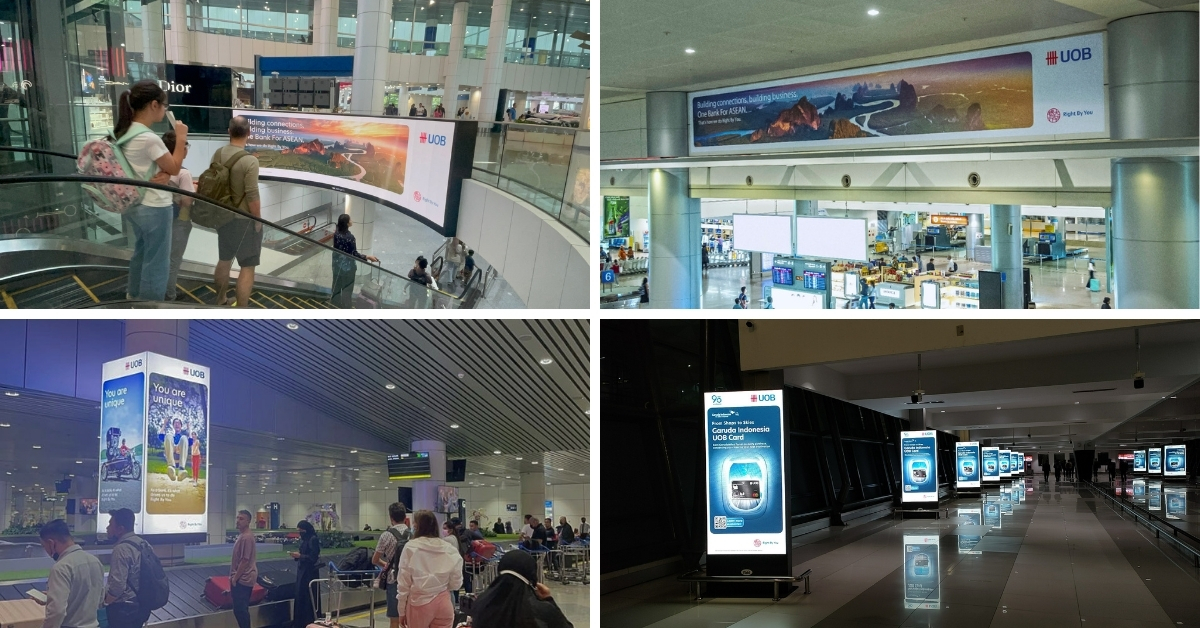
Airport OOH vs DOOH: Which Formats Should Brands Choose?
Airport / Country | Key Audience Profile | Available OOH Formats | DOOH Availability | Notable Consideration |
Changi, Singapore | Business, transit, luxury leisure | Large-format digital, experiential zones, baggage belt, column wraps | High — extensive DOOH network | Global audience; premium CPM; strong for luxury & finance |
Soekarno-Hatta T3, Indonesia | Corporate, Finance B2B | Digital screens,, corridor banners, gate areas | Only dOOH inventory | Largest Indonesian airport |
Ngurah Rai (Bali), Indonesia | International leisure, regional tourists, expats | Arrival hall displays, static banners. Event spaces | Medium; pDOOH inventory available | Exclusive sites available: Tourism-centric; ideal for hospitality, travel, lifestyle brands |
Tan Son Nhat, Vietnam | Business travellers, inbound investment, regional leisure | Digital screens, static lightboxes, check-in area branding | Medium — growing rapidly | Requires licensed local entity; TPM Vietnam subsidiary active |
Noi Bai, Vietnam | Government, diplomatic, northern Vietnam business | Terminal displays, static formats, arrival corridors | Low-Medium | Hanoi-focused audience; less tourist-heavy than HCMC |
KLIA / klia2, Malaysia | Regional transit, Malaysian domestic, South Asia connections | Large digital displays, static formats, transit corridor media | High | Strong transit audience; |
Ninoy Aquino, Philippines | OFW / diaspora, leisure, regional business | Digital screens, static backlit, departure area branding | Medium | OFW economy audience; financial and remittance, leisure entertainment brands perform well |
How to Plan a Multi-Country Airport Advertising Campaign
Audience Mapping Before Format Selection
The most common mistake brands make when planning airport advertising across ASEAN is treating it as a homogeneous channel. It is not. A campaign designed for Changi's premium global audience will need meaningful adaptation for Bali's leisure travellers or Noi Bai's government-adjacent business travellers. Audience mapping — understanding who exactly passes through each terminal, at what times, travelling for what purpose — should precede any format or location decision. This is where a regional partner with genuine on-the-ground intelligence, rather than a spreadsheet of available inventory, makes a material difference.
Dwell-Time Creative Strategy
Airport environments reward creative that respects the audience's mental state. Pre-departure passengers are alert and aspirational; arrivals are often fatigued but immediately contextualised to the destination. Creative strategies should be tailored accordingly — pre-departure zones suit discovery and aspiration; arrival halls suit welcome messaging and destination-specific calls to action. For brands running digital out-of-home in multiple terminals, dayparting and contextual triggers (flight schedules, destination routes, time of day) can significantly improve campaign efficiency.
Regulatory and Permitting Realities
Every ASEAN market has its own permitting structure for airport advertising, and the differences are non-trivial. Indonesia's airport-operator model means campaigns spanning various airports are still subjected to separate agreements. Vietnam's licensing requirements mandate local entity involvement. Malaysia's airport concessions are structured through a single operator (Malaysia Airports Holdings Berhad), which simplifies negotiation but reduces flexibility. Understanding these structural differences before committing to a regional plan is essential — and working with a partner who has already navigated them repeatedly is the fastest path to execution.
Ferry Terminal Media as a Complementary Layer
For brands targeting corridor audiences between Singapore and Indonesia, airport media should be considered alongside ferry terminal advertising. The Harbourbay and Batam Centre Ferry Terminals — both owned inventory for TPM — serve the Batam corridor, one of the busiest short-haul international routes in Southeast Asia. Audiences moving through these terminals are highly complementary to airport audiences: cross-border commuters, leisure travellers, and regional shoppers. Combining airport and ferry terminal media creates a seamless brand presence across the full Singapore–Batam travel corridor.
Measuring Airport OOH Performance
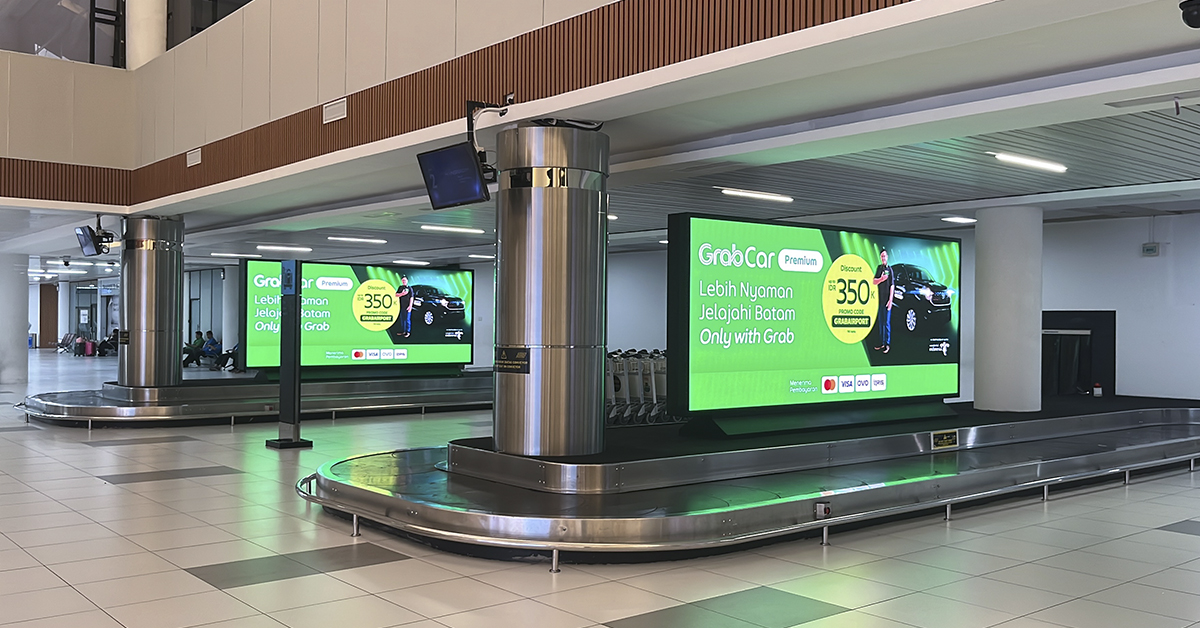
Airport media has historically been challenging to measure against digital-standard metrics, but the landscape is changing. Modern DOOH screens in major ASEAN airports now support third-party audience measurement, impression-based buying via pDOOH (programmatic Out of Home), and increasingly, attribution modelling via mobile data. For clients who have worked with TPM on campaigns such as the Grab Batam activation, integrating transit media into a broader measurable framework is increasingly feasible and expected. Brand recall studies, mobile footprint data, and post-campaign audience surveys are all viable measurement methodologies for airport OOH in 2026.
How TPM Supports ASEAN Airport and Transit Advertising
Managing airport advertising across ASEAN independently — navigating individual airport authorities, local concessionaires, regulatory bodies, and currency/contractual structures in five or six markets simultaneously — is a significant operational undertaking. The risk of fragmented execution, inconsistent creative standards, or missed permitting deadlines is real, and the cost of errors in premium airport environments is high.
The Perfect Media Group was built specifically for this challenge. With direct airport operator relationships in Indonesia, subsidiary operations in Vietnam and Myanmar, and a Singapore headquarters managing regional campaigns from a single point of contact, TPM exists to give regional marketers the simplicity of a single partner with the depth of genuine local expertise across every market. Whether the brief is a single-hub launch in Bali, a multi-country brand awareness campaign across five ASEAN airports, or an integrated strategy combining airport media with street-level OOH in Singapore's CBD, the infrastructure, inventory access, and market knowledge are already in place.
For brands that take the "Reaching The Right Millions" mandate seriously — understanding that the right audience, in the right moment, in the right environment, is always worth more than raw impressions — Asia airport advertising is one of the most powerful tools available.
Plan Your Airport Advertising Strategy with The Perfect Media Group across Southeast Asia's key hubs?
The most effective airport advertising strategy starts with the audience, not the airport's passenger ranking. Whether your objective is to reach international travellers, launch a regional brand campaign or build visibility across Southeast Asian markets, selecting the right airport, terminal and media format makes the difference.
The Perfect Media Group (TPM) helps advertisers explore OOH and DOOH opportunities across Southeast Asia, combining regional market knowledge with local media planning and execution capabilities. Speak with TPM about your campaign objectives, target markets and available airport and transit media options.
TPM's regional OOH expertise — including direct access to Indonesian airport operators and on-ground teams in Malaysia, Indonesia Medan, Indonesia Bali and Vietnam means your campaign goes from brief to live faster and smarter.
Plan Your South East Asia OOH Campaign with TPM
Tell us about your campaign and we’ll map the right OOH mix.
Talk to a TPM Strategist