
Planning an OOH campaign in Singapore? Learn how to compare media owners, understand advertising rates, review contract terms and prepare your booking checklist from choosing locations to confirming creative requirements and campaign schedules.
Why Buying OOH Advertising in Singapore Requires More Than Choosing a Billboard
Singapore has a concentrated urban population supported by an extensive transport network and established commercial districts.
According to the Singapore Department of Statistics, the country's population reached 6.21 million in June 2026. This includes residents and non-residents, but does not represent the audience reach of any individual billboard.
Source: Singapore Department of Statistics, Population Trends 2026.
For advertisers, Singapore offers access to different audience environments within a relatively compact geography.
A large-format billboard along a major traffic corridor serves a different purpose from a digital screen on Orchard Road or an advertisement near a ferry terminal arrival hall.
Each location has its own audience movement, viewing conditions and surrounding commercial activities.
That is why buying OOH advertising should begin with three questions:
Who do we need to reach?
Where and when are they most likely to encounter our advertising?
What should they understand, remember or do after seeing it?
Only after answering these questions should advertisers decide which billboard, digital screen or transit location to purchase.
The most expensive location is not necessarily the most effective. The right OOH investment depends on whether the location and format support the advertiser's specific objective.
What Types of OOH Advertising Can Brands Buy in Singapore?
Out-of-home advertising includes multiple media formats, each offering different forms of visibility, creative flexibility and audience access.
1. Static Billboards and Large-Format Outdoor Advertising
Static OOH includes printed billboards, building facades, wall-mounted advertisements and illuminated displays.
These formats are particularly suitable when an advertiser needs one clear message to remain visible throughout a defined campaign period. This is particularly good for brands in a highly competitive market such as telcos or those with a clear price offer and time limited such as the text only billboards by Singtel launched during the Chinese New Year period.
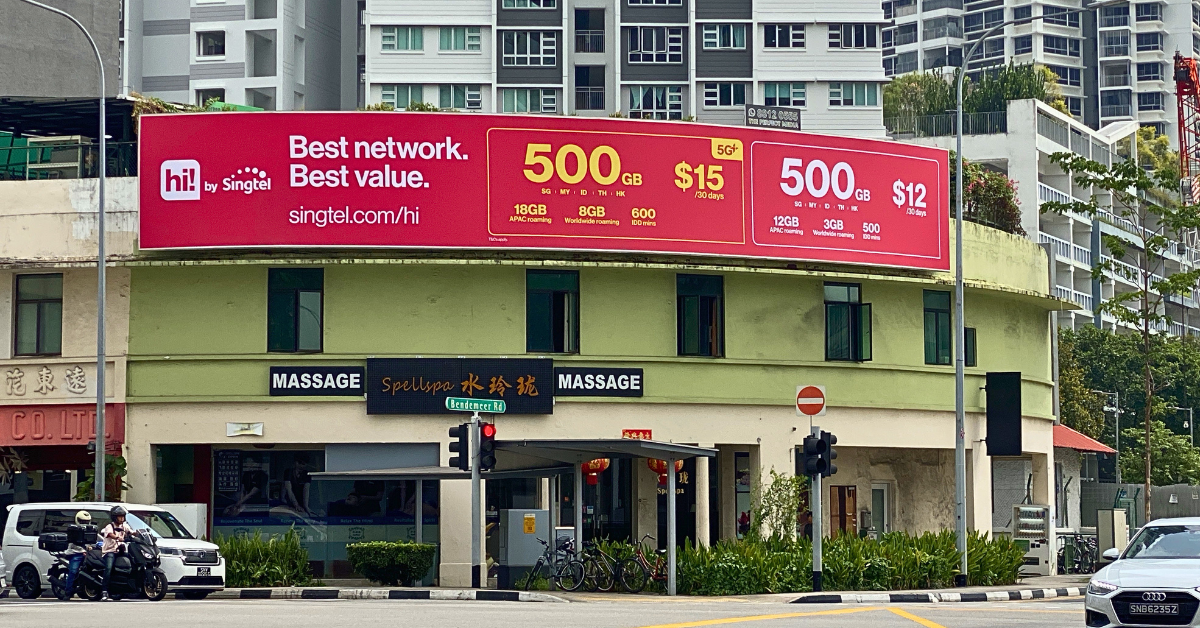
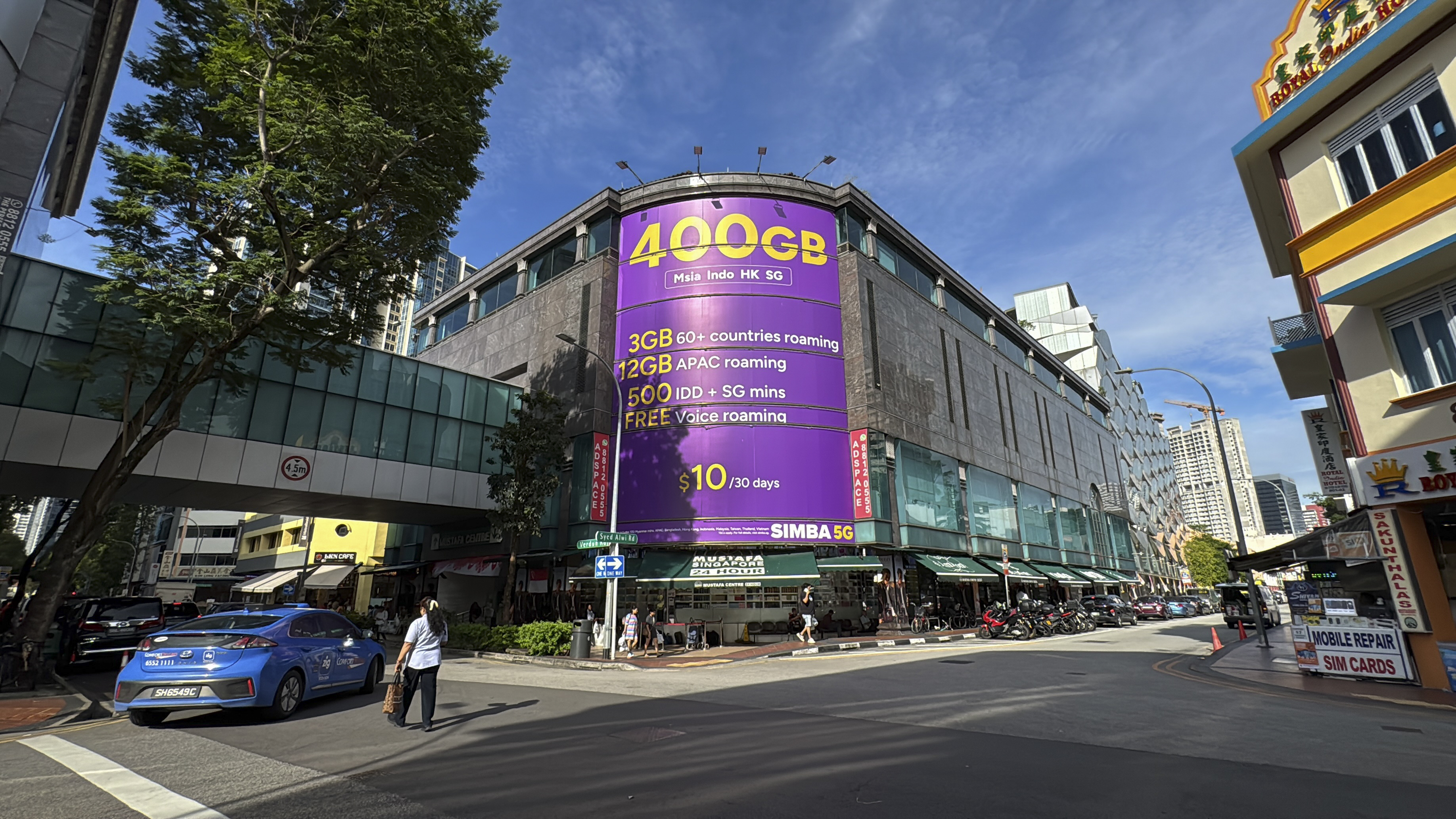
Static billboards generally provide continuous occupation of the advertising face, although actual visibility depends on lighting, obstructions and operating conditions.
For example, a corporate branding campaign along a CBD commuter corridor may benefit from a consistent message that remains unchanged throughout the campaign.
Advertisers evaluating static locations should consider viewing distance, direction of travel, surrounding advertising clutter, illumination and installation requirements.
2. Digital Out-of-Home Advertising (DOOH)
Digital out-of-home advertising uses LED screens and other electronic displays in public environments.
DOOH can support static digital artwork, animated creative and multiple campaign messages without requiring a physical change of printed material.
Depending on the operator's capabilities, advertisers will be able to schedule creative changes, coordinate campaign phases or purchase specific advertising slots. Programmatic buys via pDOOH platforms such as Vistar, Perion and Broadsign are also ways to buy OOH media with CPM measurements.
The Heeren Screen on Orchard Road is an example of a large-format DOOH location used for international brand campaigns and product launches.
However, digital advertising inventory is often shared between multiple advertisers. Buyers should understand how frequently their advertisements appear and the timing of the screen operations before comparing DOOH rates with static billboard rates.
3. Transit, Airport and Ferry Terminal Advertising
Transit OOH places advertising within passenger journeys, including railway stations, bus interchanges, airports and ferry terminals.
These environments are relevant when the advertiser's product or service connects with travel, commuting or an audience moving between locations.
Singapore's international connectivity also makes transport advertising important for regional campaigns.
For example, the Singapore-Batam travel corridor can be relevant to tourism, telecommunications, banking, e-payments, hotel group benefits and also places of interest offered in the hospitality, super apps and ride hailing transport services.
The exact terminal, passenger direction and advertising position matter. A departure hall and an arrival transport pick-up point serve different communication opportunities.
4. Street-Level and Neighbourhood Advertising
Street-level OOH includes retail-facing displays, neighbourhood billboards, pedestrian-level panels and advertising around commercial or residential areas.
Locations such as Chinatown, Little India, Jalan Besar and Queensway offer different retail and community environments including point of sales targeting nearing the shops.
For advertisers promoting everyday consumer products, local services or nearby retail destinations, the relationship between the advertisement and its surrounding businesses may be more important than overall citywide traffic.
A brand seeking relevance within a particular retail catchment may therefore benefit from a neighbourhood campaign rather than relying exclusively on a premium landmark display.
Which OOH Advertising Locations Should Brands Consider in Singapore?
The best outdoor advertising locations are not determined by size or traffic volume alone.
Advertisers should evaluate the likely audience, physical environment, commercial context and purpose of each placement.
Singapore location | Audience environment | Potential advertising objectives | Key buying consideration |
Orchard Road / Somerset | Retail, shopping, dining, entertainment and visitors | Fashion, lifestyle, technology, beauty and product launches | Premium context, screen visibility and campaign impact |
CBD / Raffles Place | Business activity and commuter movement | Financial services, corporate branding and business products | Viewing direction, commuter routes and business-day relevance |
Chinatown / People's Park | Tourism, retail, dining and community businesses | Travel, telecommunications, retail and consumer services | Pedestrian movement and surrounding commercial activity |
Little India / Serangoon Road | Cultural retail, dining, residents and visitors | Retail, remittance, telecommunications and consumer products | Specific audience fit rather than assumed demographics |
Jalan Besar / Lavender | Mixed residential, commercial and commuter activity | Consumer services, everyday products and broad urban awareness | Site visibility and repeat local exposure |
Queensway / Alexandra | Retail, residential, business and road traffic | Home products, electronics, automotive and lifestyle | Retail catchment, traffic direction and viewing conditions |
Singapore-Batam travel corridor | Cross-border passenger journeys | Tourism, transport, hospitality and regional services | Terminal, passenger direction and proximity to travel decisions |
These location descriptions are planning considerations, not verified demographic or impression data for specific advertising sites.
Orchard Road: When Brand Positioning Matters
Orchard Road is a relevant advertising environment for brands seeking visibility within Singapore's established shopping and lifestyle district.
A flagship screen such as The Heeren can support a major announcement or global product launch because the surrounding retail environment provides a context for brand discovery.
For fashion, entertainment and premium consumer products, the physical setting may contribute to how the campaign is perceived.
Orchard Road should be one of the first locations every brand considers when planning an OOH campaign in Singapore. As Singapore's iconic shopping, lifestyle and tourism destination, it offers advertisers opportunities to build visibility among local consumers and international visitors.
More importantly, advertising on Orchard Road is not limited to flagship campaigns or premium budgets. With different media locations, formats, price points and buying options such as via pDOOH, brands can choose a presence that matches their campaign objectives, advertising budget and desired exposure.
Whether the objective is a major product launch, sustained brand awareness or a targeted promotional campaign, Orchard Road offers advertising opportunities that can be tailored to different commercial needs.
CBD and Commercial Corridors: When Audience Movement Matters
The CBD attracts people travelling to workplaces, business establishments and commercial services.
For a corporate or financial-services advertiser, a display along a relevant commuter route may be appropriate. However, advertisers should not assume that every billboard labelled "CBD" reaches the same audience, especially with flexible work arrangements and work-from-home practices reshaping Singapore's office routines. After all, Thursday is the new corporate Friday, with many professionals wrapping up their in-office time a little earlier!
Business activity is no longer concentrated solely in Raffles Place, Marina Bay and the traditional CBD. Decentralised commercial hubs such as Paya Lebar, Ubi, MacPherson, Alexsandra, Dempsey and one-north also have significant concentrations of offices, businesses and working professionals.
These secondary business districts offer advertisers opportunities to reach professionals closer to their workplaces, residential neighbourhoods and daily commuting routes, potentially at different advertising price points.
For brands targeting working professionals, the better OOH strategy may be to look beyond the traditional CBD and consider where their audiences actually work, travel and spend time throughout the week.
The direction of travel, physical viewing angle, road layout and nearby businesses all affect the practical value of a placement.
Chinatown, Little India and Neighbourhoods: When Local Context Matters
Neighbourhood and cultural precincts can offer distinctive advertising opportunities.
Chinatown combines tourism, retail and dining activity. Little India has its own retail, cultural and visitor environment especially over Chinese New Year and Diwali festive periods.
These characteristics can help advertisers shortlist relevant locations. UPI at Jalan Besar and Hotel Boss
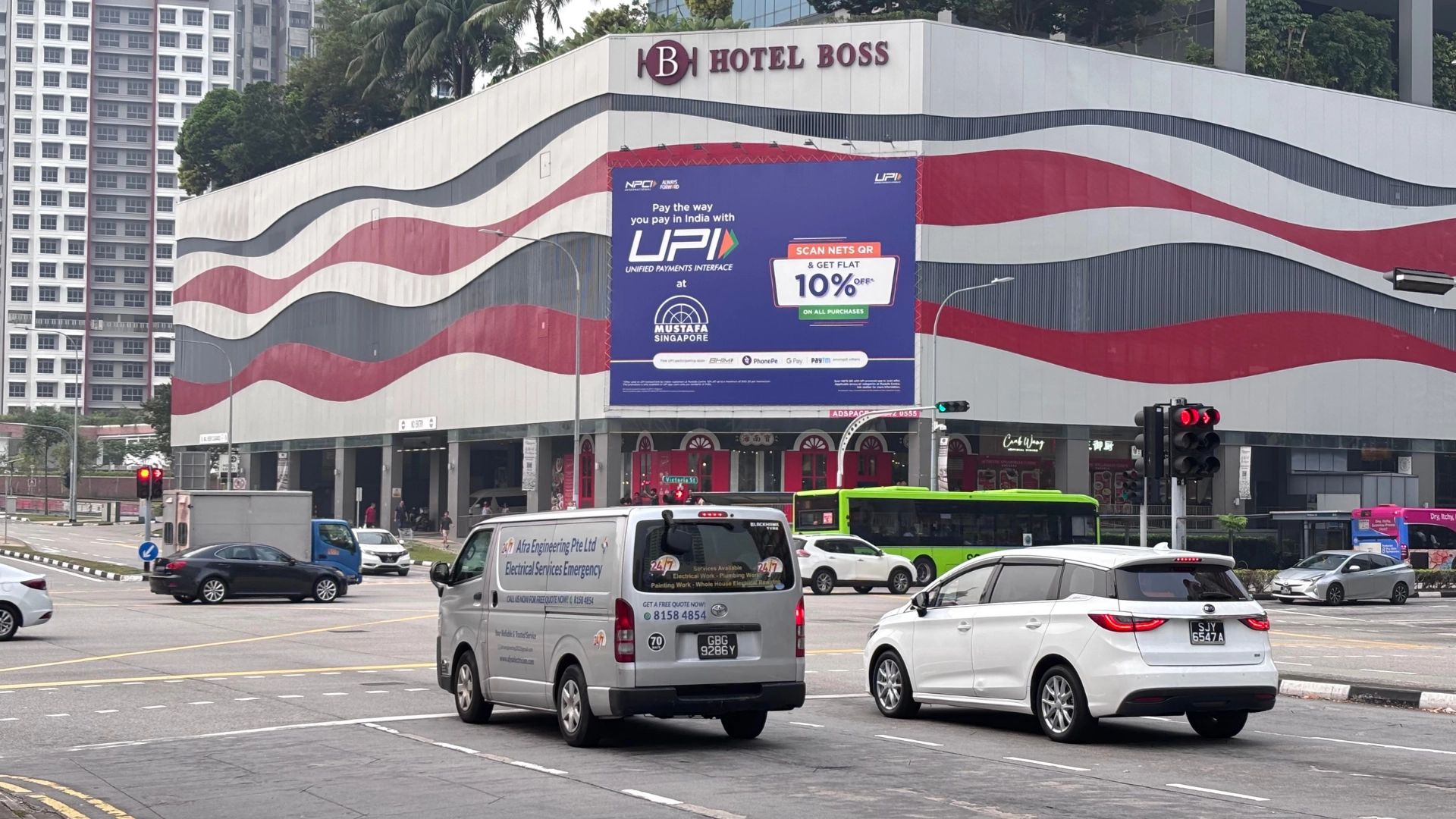
Neighbourhood and cultural precincts offer distinctive advertising opportunities, particularly for brands targeting specific consumer interests and purchasing behaviours.
For example, Chinatown and People's Park are relevant locations for advertising in Singapore for jewellery, gold trading, investment products, remittance services and financial institutions offering savings or interest-bearing products. These areas bring together established gold and jewellery retailers, financial services, tourists and local shoppers, creating a commercially relevant environment for advertisers.
The advantage of neighbourhood OOH advertising is its ability to connect brands with audiences in locations where related products, services and purchasing decisions are already part of the surrounding commercial activity.
What Real OOH Campaigns Teach Us About Choosing Locations and Formats
Case Study 1: Pokémon Legends: Z-A at The Heeren, Singapore
Advertiser: Pokémon
Location: The Heeren Screen, Orchard Road, Singapore
Format: Large-format digital out-of-home
Campaign: Pokémon Legends: Z-A global release, October 2025
The Pokémon Legends: Z-A campaign used The Heeren Screen to support different stages of its launch.
Before the official release, the creative featured a silhouette to build anticipation.
On 16 October 2025, the global release date, the advertisement changed to reveal the Pokémon in full colour. The campaign continued through the launch period.
This demonstrates a practical advantage of digital OOH: a brand can retain the same location while changing its communication according to campaign milestones.
The creative did not need to communicate every part of the launch at once.
Instead, the brand could move from anticipation to product revelation and release messaging.
Buyer lesson: When a campaign includes several important dates or messages, evaluate whether digital creative flexibility is worth more than continuous display of one static advertisement.
The value of the location was simply the size of the screen. Added to this - it was how the Orchard Road environment and digital format supported the launch sequence, tapping into the growing kidult culture among millennials who continue to embrace gaming, collectibles and beloved entertainment franchises well into adulthood especially with the strong presence of POPMART.
Source: The Perfect Media Group, Why Global Brands Choose Orchard Road for Launches in Singapore.
Case Study 2: Grab's Transport Advertising at Batam Airport and Ferry Terminal
Advertiser: Grab
Locations: Hang Nadim International Airport and Batam Centre International Ferry Terminal, Indonesia
Formats: LED screens, wall murals and lightbox advertisements
Campaign objective: Reinforce transport-service awareness among arriving passengers during key travel and festive periods
In its published campaign case study, The Perfect Media Group describes placing Grab advertisements at passenger arrival and onward-transport touchpoints in Batam.
At Hang Nadim International Airport, advertisements appeared on LED displays above baggage collection areas.
At Batam Centre Ferry Terminal, wall murals and lightbox advertisements were positioned around arrival meeting points and transport pick-up areas.
The selection was based on a specific passenger journey.
Passengers arriving in Batam may need local transportation after leaving an airport or ferry terminal. Advertising near arrival and pick-up locations places the brand within the environment where that service becomes relevant.
The case also illustrates the operational requirements of OOH buying, including media selection, content approvals, production, installation and campaign monitoring.
Buyer lesson: OOH locations should be assessed according to the decisions people may make in that environment, not simply the number of people passing through it.
Grab's media selection focused on advertising positions linked to a practical service need.
The published case study describes campaign delivery and objectives. It does not provide independently verified conversion or sales-lift figures.
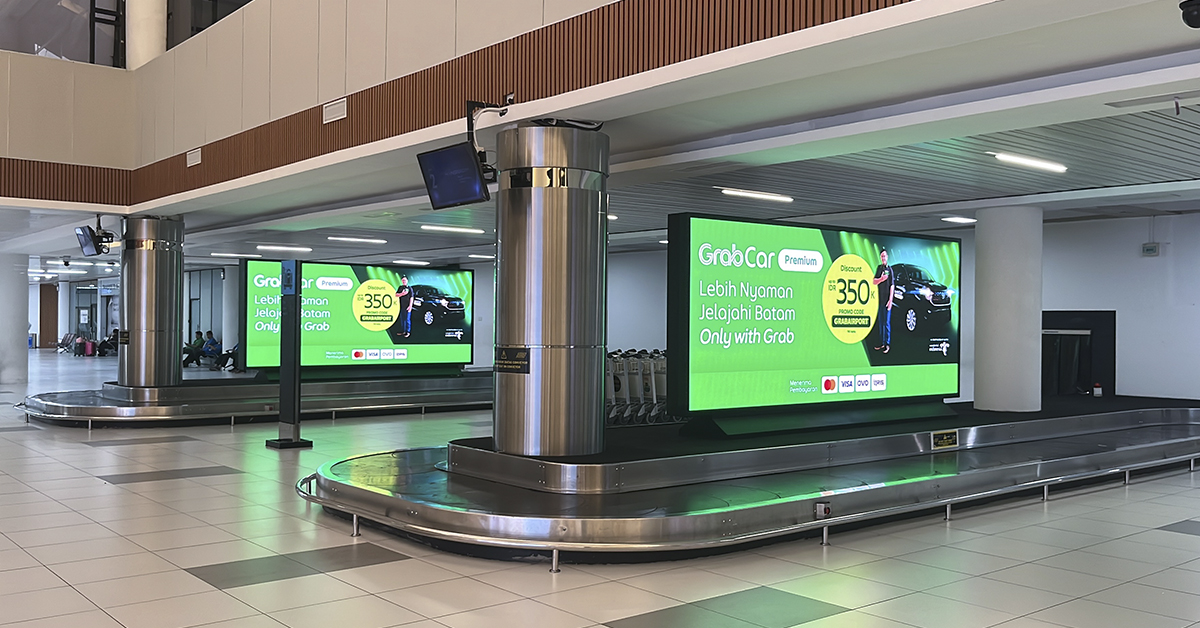
Source: The Perfect Media Group, Grab Transit Advertising at Batam Airport and Ferry Terminal.
Although the Grab execution took place in Indonesia, the planning lesson is relevant to Singapore advertisers considering coordinated regional media campaigns across transportation hubs of airports, cross border bus stations and international ferry terminals.
Should Advertisers Buy from Media Owners or Advertising Agencies?
Advertisers in Singapore can purchase OOH media directly from media owners, through specialist OOH agencies, or via programmatic digital out-of-home (pDOOH) platforms.
Each approach offers different commercial advantages depending on campaign objectives, budget, preferred locations and the level of flexibility required.
Buying consideration | Direct Media Owner | OOH Agency / Specialist | Programmatic DOOH (pDOOH) |
Best for | Specific locations, premium sites and long-term brand presence | Multi-location, multi-format or regional campaigns | Flexible digital campaigns with data-driven activation |
Inventory access | Direct access to the owner's controlled sites | Multiple media owners and formats | Digital screens enabled for programmatic buying |
Pricing | Direct negotiation and potential volume or duration packages | Negotiated rates, potentially including agency fees | Impression-based or other platform-supported pricing, potentially including technology fees |
Budget flexibility | Usually based on agreed booking packages | Can allocate budget across multiple locations | Can adjust spending and scheduling within platform and campaign constraints |
Exclusivity | May offer exclusive site or screen arrangements | Can negotiate exclusivity with media owners | Generally shared inventory; exclusivity is not standard |
Creative flexibility | Depends on static or digital format | Can coordinate multiple creative formats | Supports dynamic scheduling and eligible contextual triggers |
Audience measurement | Site-level data or independent measurement where arranged | Can consolidate measurement across locations | Platform reporting and available audience modelling |
Accountability | Direct relationship with the site operator | Agency coordinates multiple owners | Platform manages buying; physical delivery remains with screen operators |
Which Buying Method Should Advertisers Choose?
Choose a direct media owner when the campaign depends on securing a specific high-impact location, negotiating longer-term presence or developing a customised execution. This is particularly relevant for flagship product launches and landmark advertising locations such as Orchard Road.
Choose an OOH agency or specialist when the campaign requires a combination of locations, formats or markets. This can simplify media planning, procurement, creative coordination and independent reporting across different media owners.
Choose pDOOH when the campaign requires more flexible digital buying, time-based scheduling or data-informed activation across eligible screens. For example, a brand may want to concentrate advertising during selected hours or adjust its campaign according to available contextual signals.
These buying approaches are not mutually exclusive. An agency can book directly with media owners while also incorporating programmatic inventory into the same campaign.
The key commercial decision is not simply who sells the media, but which buying arrangement delivers the right locations, advertising exposure, flexibility and accountability for the available budget.
How Much Does OOH Advertising Cost in Singapore?
Singapore OOH advertising rates vary significantly according to location, format, duration, exposure, seasonal demand and operational requirements.
A static building advertisement, a rotating LED screen and an airport lightbox should not be compared simply by their monthly rental prices.
There is no reliable single rate that represents the entire Singapore OOH market.
What Determines OOH Advertising Rates?
Cost factor | What affects the price | What the buyer should verify |
Location | Commercial relevance, physical prominence and demand | Exact site and viewing position |
Format | Static billboard, LED screen, lightbox or other display | Dimensions and specifications |
Exposure | Continuous display or shared screen airtime | Display frequency, operating hours and share of voice |
Duration | Campaign period and booking commitments | Exact start and end dates |
Production | Printing, creative adaptation or animation | Whether production is included |
Installation | Labour, equipment, site access and removal | Responsibility and additional charges |
Approvals | Applicable licences, landlord approvals and content vetting | Who obtains approvals and bears costs |
Monitoring | Site inspections, photographs or proof-of-play reports | Reporting deliverables |
Taxes and fees | Applicable taxes and contractual charges | Total amount payable |
How to Compare Two OOH Quotations
Consider two hypothetical offers.
Option A: A static billboard with continuous display throughout the campaign.
Option B: A digital billboard that shows the advertisement for part of a rotating loop.
Even if both quotations cover four weeks, they do not necessarily offer equivalent exposure.
The buyer should compare visibility, audience suitability, time on screen, creative flexibility and the total payable amount.
For DOOH, request the creative duration, advertising-loop length, expected frequency and operating schedule.
For static OOH, clarify whether the media rate includes illumination, production, installation, maintenance and removal.
What About Cost per Thousand Impressions (CPM)?
CPM can help advertisers compare media costs when credible, reasonably comparable impression estimates are available.
The basic calculation is:
CPM = Total media cost ÷ Estimated impressions × 1,000
However, estimated OOH impressions depend on the audience measurement methodology.
Traffic counts, opportunities to see an advertisement and verified individual ad views are not interchangeable.
Advertisers should ask how impression estimates were calculated before relying on CPM as the main buying decision.
A low estimated CPM is not automatically a good buy if the audience is irrelevant or the advertisement is poorly positioned.
Beyond OOH: Independent Audience Measurement and Integrated Digital Media Planning
For advertisers seeking greater confidence in their media investment, The Perfect Media Group can arrange independent audience measurement to assess selected OOH locations. Depending on the site and methodology, this may include audience reach estimates, pedestrian and vehicular traffic analysis, and relevant exposure metrics to support more informed media planning and budget allocation.
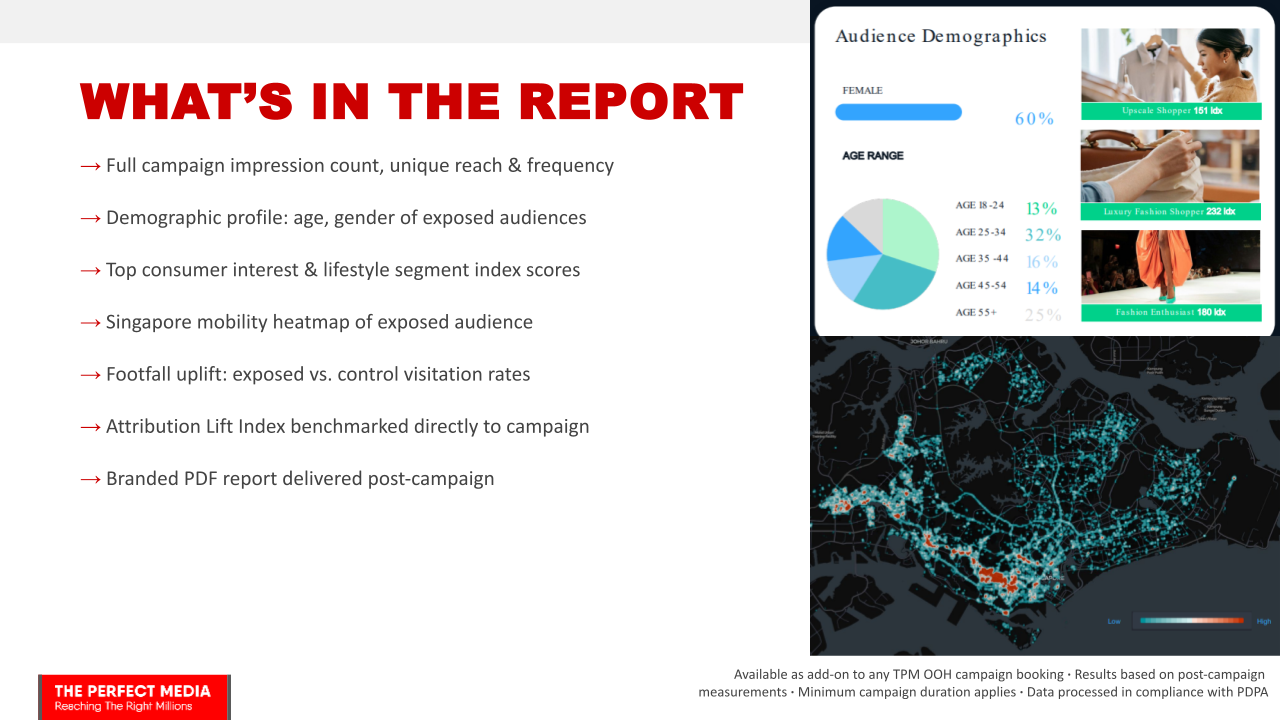
Beyond traditional OOH, TPM can also collaborate with digital media agencies and programmatic partners to develop integrated DOOH, pDOOH and mobile advertising campaigns. These complementary channels can extend campaign reach, reinforce brand messaging across physical and digital touchpoints, and support audience targeting and measurement where suitable data and capabilities are available.
By combining physical OOH presence with digital media planning, advertisers can build more coordinated campaigns across the locations, screens and devices their audiences encounter throughout the day.
OOH Advertising Contracts: What Should Buyers Check?
The media contract is as important as the selected location.
A visually attractive site can become a costly purchase if the booking conditions are unclear.
1. Exact Advertising Location and Specifications
The contract or signed media schedule should identify the actual advertising location.
For larger or multi-face installations, confirm the precise advertising face, dimensions, orientation and display specifications.
Do not rely only on a general street name or building address.
2. Campaign Dates and Display Commitments
Confirm the start date, end date and any installation or testing period.
For DOOH, confirm the agreed creative duration, advertising frequency, rotation conditions and operating hours.
If the campaign is connected to a product launch or major event, clarify what happens if the display cannot begin as scheduled.
3. Production, Installation and Removal
Determine who is responsible for artwork adaptation, printing, digital file testing, installation and removal.
For large-format displays, access equipment and site requirements may affect the production schedule and cost.
4. Approvals and Advertising Compliance
Outdoor advertising in Singapore may require regulatory approvals depending on the signage and location.
The Building and Construction Authority (BCA) administers outdoor advertisement licensing, while relevant Urban Redevelopment Authority (URA) guidelines may also apply.
BCA's published guidance states that outdoor advertising signs generally require an advertisement licence and sets out the application process.
For qualifying applications with complete documentation, BCA indicates a typical assessment period of seven working days. Additional URA evaluation may extend the process.
Advertisers should not treat those assessment periods as guaranteed approval timelines.
For media booking purposes, confirm:
Whether the location has the necessary existing approvals.
Whether the proposed advertisement requires further content or regulatory review.
Who is responsible for applications and associated fees.
Whether any industry-specific advertising restrictions apply.
What happens if the advertisement is rejected or delayed.
Source: BCA, Outdoor Advertising Sign / Signboard Licence Application.
5. Cancellation, Postponement and Replacement Media
Before signing, clarify the conditions for cancellation and postponement.
Ask whether the advertiser can change campaign dates, what charges apply and whether replacement dates or locations are available.
For digital media, discuss the treatment of downtime and missed advertising plays.
For static media, clarify the process for installation delays, damaged advertisements or temporary site obstruction.
Any compensation, replacement media or credit should be defined in the agreement rather than assumed.
6. Monitoring and Proof of Delivery
A completed booking does not by itself demonstrate that the campaign was delivered as agreed.
For static OOH, buyers may request installation and completion photographs.
For DOOH, proof-of-play reports or other technical records may be available.
The required reporting should be agreed before the campaign begins.
OOH Advertising Booking Checklist for Singapore Advertisers
Use this checklist before confirming an outdoor advertising campaign.
Stage | What to check | Why it matters |
1. Campaign brief | Objective, target audience, geographic coverage, dates and budget | Establishes the media-buying criteria |
2. Location selection | Exact address, viewing angle, audience relevance and surroundings | Prevents unsuitable site selection |
3. Media ownership | Owner, operator, agent and contracting party | Clarifies control and accountability |
4. Specifications | Display dimensions, static or digital format, operating conditions | Confirms what is being purchased |
5. Audience evidence | Traffic counts, footfall, demographic evidence and methodology where available. Independent audience measurement can also be arranged through The Perfect Media Group for advertisers requiring additional verification. | Supports the location rationale and provides an independent basis for assessing potential audience exposure |
6. Advertising exposure | Exclusive display or rotating loop, timing and frequency | Allows meaningful comparisons |
7. Financial quotation | Media rate, production, installation, removal, taxes and other charges | Establishes total campaign cost |
8. Approvals | Regulatory, landlord and creative requirements | Reduces launch risk |
9. Contract terms | Dates, payment, postponement, cancellation and remedies | Protects the advertiser's commitment |
10. Campaign delivery | Installation, monitoring, proof-of-play and completion reports | Confirms the campaign was delivered |
The strongest media proposal should make these details clear before the advertiser commits.
One Premium Site or Several Locations: Which Is the Better Buy?
Advertisers often face a choice between investing in one prominent location or distributing the budget across several advertising sites.
Neither approach is automatically better.
Choose One Premium Site When:
The campaign requires a strong flagship presence.
The selected environment reinforces brand positioning.
The creative benefits from a large or distinctive display.
The target audience is relevant to the location.
Concentrated visibility is more important than geographic coverage.
For example, an international fashion or technology launch may benefit from a prominent Orchard Road display when the retail environment supports its intended positioning.
Choose Multiple Locations When:
The campaign targets audiences across several geographic areas.
Retail or service destinations are spread across Singapore.
The advertiser needs visibility across different audience journeys.
Repeated local presence matters more than one flagship location.
For example, a consumer-services campaign could evaluate a combination of CBD, neighbourhood and transit locations to reach different audience environments.
However, adding more sites does not automatically create better reach.
Advertisers should consider whether the locations complement each other or simply repeat exposure to similar audiences.
What Are the Most Common Mistakes in OOH Media Buying?
Buying Based on Traffic Volume Alone
Traffic volume does not guarantee advertising exposure or audience relevance.
A heavily travelled road may have poor viewing conditions, while a smaller pedestrian location may offer better message visibility for a relevant audience.
Comparing Rates Without Comparing Exposure
A static billboard with continuous display and a DOOH screen with rotating advertisements represent different media propositions.
Compare actual display conditions before assuming one quotation offers better value.
Ignoring Production and Approval Timelines
A booked advertising site may still require artwork preparation, site access, content vetting or regulatory approvals.
Launch-critical campaigns should establish these requirements before confirming production and booking dates.
Failing to Define Reporting Requirements
Agree on the evidence of campaign delivery before signing the booking.
Without a clear reporting agreement, disputes about installation, display duration or digital airtime may be harder to resolve.
Frequently Asked Questions About Buying OOH Advertising in Singapore
1. How much does OOH advertising cost in Singapore?
OOH advertising costs in Singapore depend on the specific location, format, advertising exposure, duration and production requirements. Premium locations and large-format displays may command different rates from neighbourhood or smaller-format media. Advertisers should request site-specific quotations showing the full cost, including production, installation and applicable fees. Within The Perfect Media group, our range of inventory can be $150 to up $30,000 per week subject to location and size of screen inclusive of all costs except government tax.
2. How far in advance should advertisers book OOH media in Singapore?
Booking lead times depend on inventory availability, campaign timing, production requirements and approval conditions. Premium locations and major campaign periods may require earlier planning and queuing due to its static nature. Advertisers should confirm availability and establish a realistic production schedule before committing to public launch dates.
3. Is it better to book OOH advertising directly from media owners?
Direct booking can provide access to the operator responsible for the location, specifications and campaign delivery. However, an OOH agency may be more suitable when a campaign requires inventory across multiple media owners. Buyers should compare the service scope, pricing, accountability and operational capabilities rather than assuming either buying method is universally better.
4. Is a static billboard better than a digital OOH screen?
Static billboards are suitable when advertisers want continuous display of one consistent message. Digital OOH screens offer creative flexibility and may support different messages or campaign stages, but often rotate advertisements. The better option depends on the communication objective, share of voice, audience and overall cost.
5. Can advertisers get exclusive use of a DOOH screen?
Yes! Some digital advertising locations may offer exclusive or higher-share-of-voice arrangements, depending on inventory availability and commercial conditions. Advertisers should confirm whether the quotation covers a standard rotating slot, additional airtime or exclusive display. Exclusivity should be explicitly documented in the agreement.
6. What happens if an OOH advertisement cannot be displayed as booked?
The outcome depends on the contract. Advertisers should establish in advance how delayed installation, reasons such as government retraction of prior approvals, screen downtime, missed plays, cancellations and unavailable sites will be handled. Possible remedies may include replacement display time, alternative media or financial adjustments, but these should not be assumed unless agreed.
What Should Advertisers Learn Before Buying OOH in Singapore?
Three principles should guide an outdoor media investment.
First, buy the audience opportunity, not simply the location name. Orchard Road, the CBD, Chinatown and neighbourhood locations offer different commercial environments. Select them according to the campaign objective.
Second, compare the full advertising proposition, not just the media rate. Display frequency, viewing conditions, production, approvals and monitoring all affect the value of an OOH purchase.
Third, define operational accountability before booking. Understand who controls the media, who is responsible for campaign delivery and what happens if the agreed display cannot proceed.
A good OOH media plan should make it easy for the advertiser to understand why each selected location is included and what the overall investment is expected to accomplish.
Plan Your OOH Advertising Campaign in Singapore and Indonesia with The Perfect Media Group
The best OOH media buy is not necessarily the largest billboard, the most expensive screen or the cheapest quotation.
It is the combination of audience relevance, location visibility, suitable creative, commercial value and reliable execution.
The Perfect Media Group works with advertisers on outdoor advertising planning, media location selection, production coordination and campaign execution across Singapore and regional markets.
For advertisers seeking additional accountability, TPM can also arrange independent audience measurement to support media planning and investment evaluation. This enables brands to assess selected advertising locations using independently developed audience estimates and relevant exposure data, subject to the agreed measurement scope and methodology.
Its published work includes international brand campaigns at The Heeren Screen on Orchard Road and transport-related advertising placements in Indonesia, demonstrating different approaches to physical audience engagement.
For advertisers considering a new campaign, the first step should be to establish the audience, objective, timing and budget before selecting individual advertising sites.
Planning an OOH campaign in Singapore?
Contact The Perfect Media Group to discuss your target audience, advertising objectives and budget. Our team can help you evaluate suitable OOH locations, compare media formats and develop a practical campaign plan before you commit to a booking.